People’s Republic of China


CCTV: We noted that over the past two days, Foreign Minister Wang Yi had phone calls with his counterparts from Kuwait, Bahrain, Pakistan and Qatar for exchanges of views on the situation in Iran. But meanwhile, tensions in the region ratchet up, and risks of conflict escalation and spillover grow. Could you give us more information on China’s position and efforts to promote deescalation? How does China view the future development?
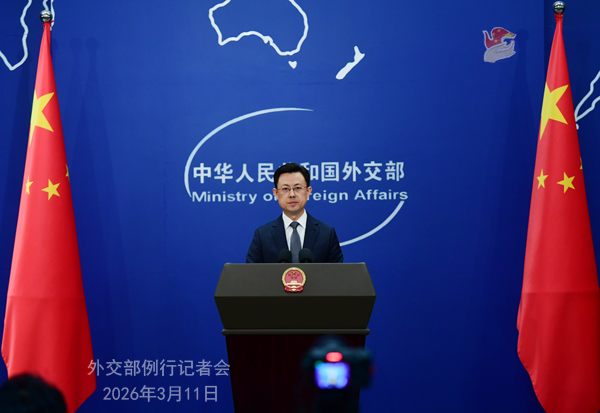
Guo Jiakun: On the situation in Iran, Foreign Minister Wang Yi has recently reached out to relevant parties and once again communicated with his counterparts of regional countries through phone calls to call for peace, end to hostilities and deescalation.
Foreign Minister Wang Yi pointed out that this is a war that should not have happened—it is a war that does no one any good. Without the UN’s authorization, the U.S. and Israel attacked Iran in the process of the ongoing U.S.-Iran negotiation, which clearly violates international law. Countries’ sovereignty, security and territorial integrity should be respected. China does not go along with attacks against countries in the Gulf region and condemns nondiscriminatory attacks against civilians or non-military targets. The pressing priority now is to stop military operations at once and prevent the conflict from spreading. The way out of the conflict is to return to dialogue and negotiation as soon as possible and strive for restoration of peace. The fundamental solution is to jointly return to the right track of abiding by international law and basic norms of international relations.
Since the very first day of the conflict, China has unequivocally called for ceasefire, end of hostilities, return to dialogue and negotiation, and political settlement. As we speak, Special Envoy of the Chinese Government on the Middle East Issue is in the Middle East to carry out shuttle diplomacy. As a permanent member of the UN Security Council and sincere friend of Middle Eastern countries, China will stay committed to urging peace and defending justice and fairness. China will continue to strengthen communication with relevant parties, including parties to the conflict, and play a constructive role for deescalation and restoration of peace.
Shenzhen TV: It’s reported that 16 UN experts of the special procedures of the Human Rights Council in a joint press release expressed grave concern at Japan’s denial of the right to truth, justice and reparation of survivors of the “comfort women” system, and called on Japan to make official apologies and adequate compensation. They also stressed the importance of preserving historical memory through educational materials. What’s China’s comment?
Guo Jiakun: The forced recruitment of “comfort women” was an atrocious crime committed by Japanese militarists. This heinous act severely trampled on the rights of the victims and was an undeniable fact backed by solid evidence. The UN human rights mechanism made a clear statement to once again express condemnation and outrage over Japanese militarists’ crime and demonstrate the international commitment to defending fairness and justice.
We urge Japan to repent for the history of aggression and the suffering it inflicted on the victims, heed and act on the suggestions given by UN human rights experts, properly handle the issue of “comfort women” and other issues left over from history with honesty and a sense of responsibility, and take concrete actions to earn trust from its Asian neighbors and the international community.
AFP: The shipping company COSCO is reportedly suspending its operations at Balboa port on the Panama Canal. Panama Supreme Court earlier this year annulled CK Hutchison’s contract to that port. Could you confirm COSCO suspending its operations there and provide any details of the reasons?
Guo Jiakun: I’m not familiar with that. I’d refer you to competent authorities.
Bloomberg: The Pentagon is moving parts of its THAAD air defense system from South Korea to the Middle East. Does China have a comment on this? Will China oppose the U.S. returning those weapons to South Korea in the future?
Guo Jiakun: We noted relevant reports. China’s opposition to the U.S. deployment of THAAD anti-missile system in the ROK remains unchanged.
PTI: The Indian government yesterday eased norms for foreign investments from neighborhood countries, especially China. It comes in the backdrop of the easing of relations between the two countries after five years of freeze between the two countries. I would like you to have a comment on this particular decision by the Indian government.
Guo Jiakun: I’d refer you to competent authorities.
AFP: The U.S. said that it struck what it says Iranian boats being used to lay mines in the Strait of Hormuz. I wondered if you have any comment on the potential mining of the Strait? Has China had any talks with Iran or others on keeping the Strait open?
Guo Jiakun: We are gravely concerned over the ongoing tense situation in the Middle East. The pressing priority now is that relevant parties should stop the military operations at once, return to the track of dialogue and negotiation as soon as possible, and avoid further escalation and deterioration of the situation.
PTI: I have a question regarding the shuttle diplomacy. Is this particular diplomacy focused in the Gulf region? Or is it being extended to Israel and the U.S. as well to bring about a kind of ceasefire to halt the war, at least at present? Is the Chinese government also in touch with the U.S. on these particular diplomatic efforts?
Guo Jiakun: I just shared China’s mediation efforts in answering an earlier question. You may also have noted a recent phone call between Foreign Minister Wang Yi and his Israeli counterpart. As we speak, Special Envoy of the Chinese Government on the Middle East Issue is visiting the region, as part of China’s efforts to help bring about an immediate stop to the military conflict and to bring parties concerned back to the track of dialogue and negotiation to avoid further escalation of the situation. China will continue to maintain communication with all relevant parties, including parties to the conflict.