People’s Republic of China


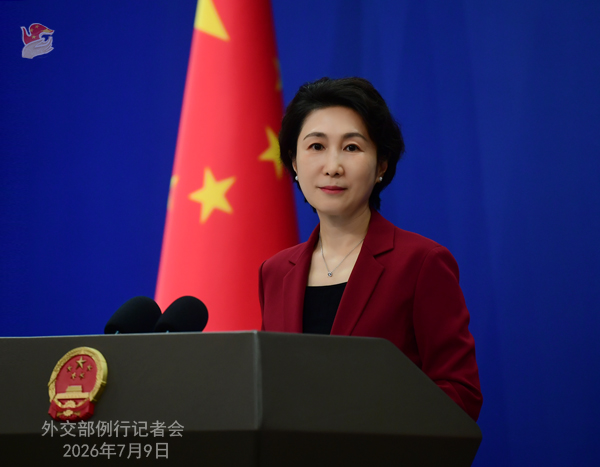
At the invitation of the Central Committee of the Communist Party of China and the government of the People’s Republic of China, Pak Thae Song, Member of the Presidium of the Political Bureau of the Central Committee of the Workers’ Party of Korea, Vice President of the State Affairs Commission of the Democratic People’s Republic of Korea (DPRK) and Premier of the Cabinet will lead a party and government delegation to China to pay an official visit and attend the commemorative event of the 65th anniversary of the China-DPRK Treaty of Friendship, Cooperation and Mutual Assistance from July 10 to 12.
Xinhua News Agency: Can you brief us on the backdrop and China’s expectation of DPRK Premier of the Cabinet Pak Thae Song’s visit?
Mao Ning: China and the DPRK are traditional friends and close neighbors. It is an unswerving strategic policy of the CPC and the Chinese government to maintain, consolidate and develop China-DPRK relations. This year marks the 65th anniversary of the China-DPRK Treaty of Friendship, Cooperation and Mutual Assistance. The two sides agreed to jointly hold commemorative events. China stands ready to work with the DPRK to follow the guidance of the important common understandings between the top leaders of the two parties and two countries, step up strategic communication, enhance exchanges and cooperation, and further advance China-DPRK traditional friendship and cooperative ties.
UOL of Brazil: Chinese open-source AI is an increasingly attractive alternative for the Global South, as well as for developed nations. Do you expect the technological cooperation around open-source AI, between China and developing countries, to deepen in the years ahead? What steps may China take to advance this goal?
Mao Ning: Open-source and accessible AI is humanity’s common asset. China actively acts on the Global AI Governance Initiative put forward by President Xi Jinping, implements the Global AI Governance Action Plan, and strives to provide international public goods to help Global South countries enhance AI capacity-building. China’s open-source models, such as DeepSeek and Qwen, have significantly made AI more accessible and affordable, enabling all parties, especially developing countries, to benefit equitably from AI development.
From July 17 to 20, China will hold the 2026 World AI Conference & High-Level Meeting on Global AI Governance in Shanghai. Through this event, we are ready to work with all sides to discuss technological innovation, promote result-driven empowerment, and foster an inclusive ecosystem, so as to advance AI development for good and for all and inject new impetus to global AI advancement.
CGTN: The 62nd Session of the United Nations Human Rights Council held in Geneva has just been concluded. Could you brief us on China’s participation in this session?
Mao Ning: The 62nd Session of the United Nations Human Rights Council was held from June 15 to July 8 in Geneva. During this session, the Chinese delegation, guided by the Global Governance Initiative put forward by President Xi Jinping, acted on Foreign Minister Wang Yi’s important propositions on reforming and improving global governance including recalibrating the direction of international human rights governance, and gave full play to the role of the Group of Friends of Global Governance. China delivered a joint statement on AI for accessibility on behalf of 67 countries, advocating digital technology for good and for all and bridging the global digital divide. In another joint statement on behalf of a group of nearly 20 countries, China opposed tariff abuses by certain countries and called for efforts to keep global industrial and supply chains stable and uphold the global economic and trade order. China also spoke out on the issue of migrants, calling on relevant countries to protect their lawful rights and interests and eliminate systemic racial discrimination. Besides, China co-hosted with UN Women and other partners a thematic event on Beijing+30, sharing China’s progress in protecting women’s rights and galvanizing efforts to implement the Beijing Declaration.
Going forward, China will continue its efforts to implement the Global Governance Initiative, practice true multilateralism, promote dialogue and cooperation at the Human Rights Council, reject attempts to politicize, instrumentalize or weaponize human rights, and work to build a just, equitable and inclusive global human rights governance system.
AFP: Media outlets in Taiwan are reporting that China’s recent long-range submarine launch missile test was actually fired from the sea surface south of Guangdong rather than from underwater. Does the foreign ministry have a comment on this?
Mao Ning: We have stated our position on the test launch on multiple occasions. I don’t have anything further to add.
Reuters: Also on the test launch, the U.S. State Department has criticized China’s recent missile test launch and said that China notified the U.S. too late and didn’t give sufficient detail. The U.S. said the notification by China fell short of the standards that are adhered to by the P5 nuclear weapon states. What is the foreign ministry’s response to those remarks?
Mao Ning: China has stressed more than once that the test launch is a routine arrangement in China’s annual military training program designed to verify the reliability, safety and effectiveness of relevant weapon systems. The activity complies with international law and customary international practice and is not directed at any specific country or target. The Chinese side has released relevant information in a timely manner and notified the U.S. and other countries beforehand, which demonstrates the openness and transparency of the Chinese military.
The U.S. is the only country to have actually used nuclear weapons. It sits on the world’s largest and most advanced nuclear arsenal, and launches strategic missiles from nuclear-powered submarines annually. Yet it points fingers at China’s routine missile launch—a typical example of double standards and hegemonism. The U.S. needs to view the development of China’s national defense and military in an objective and rational light and earnestly uphold global strategic stability.
Beijing Daily: On July 7 local time, the UN General Assembly voted overwhelmingly to proceed with a debate on “the necessity of ending the economic, commercial and financial embargo imposed by the United States against Cuba.” In total, 136 nations voted in favor, 30 abstained, and 9, including the U.S., voted against. What’s your comment?
Mao Ning: The U.S. has put in place blockade and sanctions on Cuba for over six decades and recently intensified its measures. Such moves caused an energy crisis, constitute a severe violation of the purposes and principles of the UN Charter and other basic norms governing international relations, seriously infringe upon Cuba’s right to survive and thrive, and has wreaked havoc on the Cuban people.
The UN General Assembly’s overwhelming vote to hold the debate once again reflects the extensive international support to the Cuban people for their effort to safeguard national sovereignty and oppose external interference and blockade. It’s yet another evidence that unilateral and bullying moves find no support.
The U.S. needs to heed the call for justice from the international community, and immediately lift its blockade, sanctions and any forms of coercion, pressuring and military threat against Cuba. China will work with the international community to firmly defend international fairness and justice and support Cuba in safeguarding its national sovereignty and dignity, and opposing external interference.
AFP: We understand that recently a group of people in Thailand gathered at the Chinese embassy and consulates in the country to protest heavy metal contamination in a tributary of the Mekong river. Does the foreign ministry have an additional comment on this on top of the statement that the Chinese embassy has already put out? In the statement, it mentioned that it would expedite a joint investigation with Thailand and Myanmar on this issue.
Mao Ning: China is ready to strengthen cooperation in water resources and ecological conservation with Mekong countries including Thailand. We support Thailand and Myanmar in stepping up communication and coordination, conducting investigations in an objective, science-based and responsible approach, and resolving the issue through friendly consultation.
ORF: During the recent NATO summit, security concerns about China were raised in terms of technology, military activities, and its relationship with Russia. What is China’s comment on these three issues?
Mao Ning: NATO is a regional defense alliance with clearly-defined scope of mission and geographic boundaries. It needs to stop finding fault with China at every turn. China is a force for world peace. It never threatens anyone, nor does it pose a challenge to Euro-Atlantic security. NATO should discard Cold War mentality, have a right perception on China, and stop hyping up “China threat” narratives.
Bloomberg: The New Zealand prime minister has said that New Zealand will work to join a new military alliance that was signed this week between Australia and Fiji. I wonder if the foreign ministry has any comment?
Mao Ning: China advocates pursuing common, comprehensive and cooperative security. Security cooperation between countries should be open, inclusive and truly conducive to keeping the region peaceful and stable.
Reuters: The U.S. State Department said in a statement that it supports the aspirations of Tibetans to preserve their culture and has called on China to return to dialogue with the Dalai Lama. Does the foreign ministry have any comment on the remarks by the U.S. State Department?
Mao Ning: Xizang-related affairs are purely China’s internal affairs and no country has the right to make interference. We urge the U.S. to honor its commitment that it recognizes Xizang is part of China and does not support “Tibet independence,” and stop using Xizang-related issues to interfere in China’s internal affairs.