People’s Republic of China


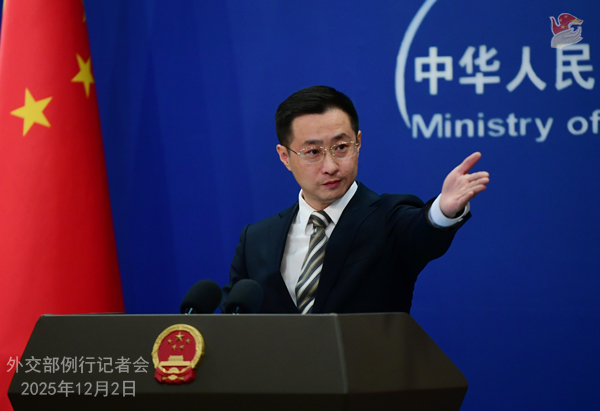
Shenzhen TV: In the letter to the UN Secretary-General on November 24, Japan’s Permanent Representative to the UN said that China’s assertion that Japan would exercise the right of self-defense even in the absence of an armed attack is erroneous; Japan’s fundamental defense policy is the posture of passive defense strategy, which is exclusively defense-oriented; the remarks by the Prime Minister of Japan Sanae Takaichi are grounded in this position; the international community should oppose the approach of imposing coercive measures against other countries’ statements and policies. What’s China’s comment?
Lin Jian: Japanese Prime Minister Sanae Takaichi’s erroneous remarks on Taiwan openly challenge the victorious outcomes of World War II and the post-war international order, and constitute a serious violation of the purposes and principles of the Charter of the United Nations. China’s letter to the UN Secretary-General setting out our solemn position was entirely justified and necessary.
The letter by the Japanese side is full of erroneous views and lies. The Japanese side mentioned in the letter the so-called “consistent position” on the Taiwan question. But as to what exactly this “consistent position” is, the Japanese side has continued to evade the question and has yet to give China a direct answer. We ask the Japanese side once again: Can the Japanese government provide the international community with a complete and accurate explanation of its “consistent position” on the Taiwan question as laid down in the four political documents between the two countries?
The Japanese side claims that Japan adheres to a “passive defense strategy, which is exclusively defense-oriented,” and asserts that Takaichi’s remarks were grounded in this position. Taiwan is Chinese territory. How to resolve the Taiwan question is a matter for the Chinese ourselves and brooks no external interference. Yet Takaichi linked Japan’s “survival-threatening situation” with a “Taiwan contingency,” implying the use of force against China. Is this what the Japanese side’s “passive defense strategy, which is exclusively defense-oriented,” means?
In Article 2(4) of Chapter I, the Charter of the United Nations stipulates that “All Members shall refrain in their international relations from the threat or use of force.” As the sitting leader of a defeated country in WWII, Takaichi threatened a victorious country with the use of force in case of a “survival-threatening situation.” How could the Japanese side have the audacity to claim that it “has always respected and adhered to international law, including the UN Charter”?
The Japanese side also insinuates accusations regarding the defense development and “coercive measures” of other countries. This is nothing but blame-shifting. In fact, since Japan’s defeat, right-wing forces within Japan have never ceased attempts to whitewash its history of aggression. Japan has increased its defense budget for 13 consecutive years, removed the ban on exercising the right to collective self-defense, relaxed restrictions on arms exports more than once, developed the capability to strike enemy bases, attempted to alter the “three non-nuclear principles,” further hollowed out the provisions on Japan clearly stipulated in the Cairo Declaration and the Potsdam Proclamation, and gone back on its commitments made in the constitution. It is the Japanese side, not others, that has been “engaged in the prolonged expansion of military capabilities”, taking “coercive measures” and attempting “unilateral changes to the status quo despite opposition from neighboring countries.”
Given all these reasons, the Permanent Mission of China to the UN once again sent a letter to the UN Secretary-General and reiterated the Chinese side’s stern position. This year marks the 80th anniversary of the victory of the Chinese People’s War of Resistance Against Japanese Aggression and the World Anti-Fascist War. China firmly opposes the Japanese side reversing the course of history, challenging the postwar international order, and honoring the militarists. We once again urge the Japanese side to earnestly do soul-searching, rectify its wrongdoings, fulfill its obligations as a defeated country, take practical steps to honor its commitments to China and the international community, and stop reneging on its words again.
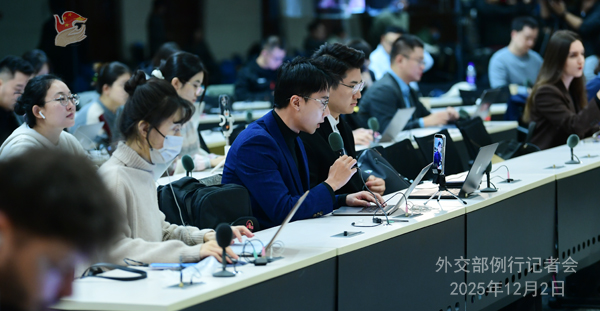
RT TV: Yesterday Russian President Vladimir Putin signed an executive order, granting a visa-free policy to Chinese nationals. Starting from yesterday, Chinese friends have the right to enter Russia without obtaining a visa for business visits, as tourists, or to take part in scientific, cultural, or sports events. What is China’s comment?
Lin Jian: That is good news. Mutual visa exemption between China and Russia is the latest example of closer government-to-government and people-to-people ties. The measure will give an all-round boost to the friendship, exchanges, and cooperation between the two countries. We sincerely hope to see more Chinese and Russians discovering each other’s beautiful countries through visa-free tours.
TV Asahi: It’s reported that some Japanese organizations, such as the Japan-China Friendship Parliamentarians’ Union and Keidanren (Japan Business Federation), have conveyed to the Chinese side their willingness to visit China in the near future. Will China arrange their visits?
Lin Jian: We noted the reports and also found that many visionary people in Japan are deeply concerned over the negative influence and grave consequences of Prime Minister Sanae Takaichi’s erroneous remarks on Taiwan. The Chinese side urges the Japanese side to do soul-searching, rectify its wrongdoings, retract Prime Minister Sanae Takaichi’s erroneous remarks, stop harming the sentiments of the two peoples, take practical steps to honor its political commitments to China, and create necessary conditions for the normal exchanges between the two countries. We hope relevant Japanese organizations will play a more positive role in Japan.
Bloomberg: Taiwan’s “foreign minister” said that the dispute between China and Japan could drag on for a year. Would the Foreign Ministry like to comment on that?
Lin Jian: Taiwan is part of China, and there is no such thing as “foreign minister” of Taiwan. The difficulty facing China-Japan relations is simply due to Japanese Prime Minister Sanae Takaichi’s erroneous remarks on Taiwan. The Japanese side should honor its political commitments to China, retract the erroneous remarks and take practical steps to do soul-searching and correct its wrongdoings. Any external force who dares to meddle in the affairs on the Taiwan Strait will face a resolute, head-on blow from China. The DPP authorities’ ill-intentioned attempts are rather disgraceful and their moves to seek independence by soliciting foreign support will lead nowhere.
Reuters: The question is on Honduran presidential elections. I want to ask are there any concerns from China that the new Honduran president will end diplomatic relations with China, and whether there were any conversations between Chinese diplomats and the Honduran presidential candidates?
Lin Jian: The presidential election is the domestic affair of Honduras. China follows the principle of non-interference in other countries’ internal affairs. Let me point out that since the establishment of China-Honduras diplomatic relations in March 2023, the relationship has grown rapidly with fruitful cooperation in various fields and tangible benefits for the two peoples. China stands ready to work with Honduras to further advance bilateral relations on the basis of the one-China principle and better benefit our two peoples.