People’s Republic of China


At the invitation of the World Economic Forum and the government of the Swiss Confederation, Member of the Political Bureau of the CPC Central Committee and Vice Premier of the State Council He Lifeng will attend the World Economic Forum Annual Meeting 2026 in Davos and visit Switzerland from January 19 to 22.
China Daily: Can you brief us on the arrangement of Vice Premier He Lifeng’s attendance at the World Economic Forum Annual Meeting 2026 and what does China expect to achieve through the event?
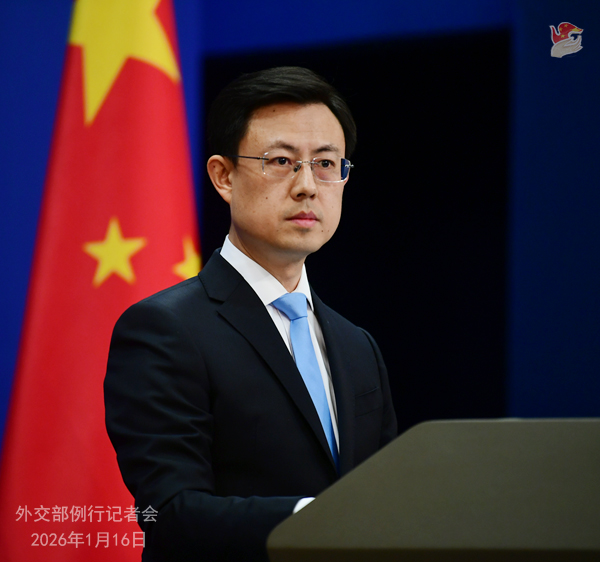
Guo Jiakun: The World Economic Forum Annual Meeting is an important platform for discussions on global economic trend and on how to promote cooperation and development, and is known as the “wind vane of the world economy.” Vice Premier He Lifeng will attend and address the opening plenary of the annual meeting.
The theme of this year’s annual meeting is “A Spirit of Dialogue.” In a world fraught with uncertainties and instabilities and struggling to find drivers for growth, China looks forward to working with all participating parties to increase dialogue and exchanges, pool consensus for cooperation, practice true multilateralism, jointly build an open world economy, strive for global development that is more inclusive, resilient and beneficial for all, and inject more stability and positive energy for the world economy.
Reuters: The U.S. and Taiwan signed a trade deal on Thursday that cuts tariffs on many of Taiwan’s exports and directs new investment into the U.S. technology industry. Does the Foreign Ministry have any comment?
Guo Jiakun: China firmly opposes the negotiating and signing of any agreement with sovereign connotations and an official nature between China’s Taiwan region and countries having diplomatic relations with China. The U.S. needs to earnestly abide by the one-China principle and the three China-U.S. joint communiqués.
RT TV: Japan and the Philippines signed an agreement recently to enhance mutual support and cooperation on military logistics. The Japanese side said that it will provide the Philippines with security assistance worth millions of U.S. dollars to boost the so-called “quasi-alliance.” What is China’s comment? If the agreement comes into effect, what’s China’s assessment on its possible impact on regional peace and stability?
Guo Jiakun: China always believes that cooperation between states should not target any third party or harm the interests of any third party; nor should such cooperation undermine regional peace and stability.
During World War II, Japanese militarists invaded the Philippines, oppressed the Philippine people and servicemen from the Allied Nations with force and coercion, and ruthlessly killed Chinese diplomatic and consular officials. That part of history must be remembered, those atrocities must be accounted for, and justice must be delivered for such crimes.
Despite criticism from Southeast Asian countries and the international community over latest military and security developments in Japan, the Japanese side has shown no inclination to mend its conduct, and instead made up various pretexts to expand military buildup and export deadly weapons, further revealing Japanese right-wing forces’ motive to remilitarize Japan and go back to the path of military expansion. All peace-loving countries and people must firmly reject a revival of militarism and remilitarization in Japan and keep the region peaceful and stable.
CCTV: Can you share the arrangement of Vice Premier He Lifeng’s visit to Switzerland? What’s China’s comment on its relations with Switzerland?
Guo Jiakun: While in Switzerland, Vice Premier He Lifeng will meet with President of the Swiss Confederation and Head of the Federal Department of Economic Affairs, Education and Research Guy Parmelin. Over recent years, with the concerted effort of both sides, China-Switzerland relations have achieved comprehensive improvement, practical cooperation has continuously produced new outcomes, negotiations on an upgrade of the free trade agreement have made steady progress, and the two sides have both voiced support for multilateralism and the reform and improvement of global governance. This year marks the tenth anniversary of the China-Switzerland innovative strategic partnership. It is also the first year of China’s 15th Five-Year Plan period. China-Switzerland cooperation faces new opportunities. Vice Premier He Lifeng’s visit will galvanize effort from both sides to further expand cooperation areas and achieve more mutually-beneficial outcomes in the China-Switzerland innovative strategic partnership.
Beijing Youth Daily: The handover ceremony of the chairmanship of the Group of 77 and China was held at the UN Headquarters this week. Uruguay took over the chairmanship for the year 2026. Speaking at the event, UN Secretary-General Antonio Guterres said the G77 remains “a strong pillar of multilateralism” and “its mission is as urgent as ever.” What’s China’s comment? Can you share China’s expectation of the work of the Group of 77 and China in 2026?
Guo Jiakun: China congratulates Uruguay on taking over the chairmanship of the G77 and China for the year 2026. The G77 and China is an important force in safeguarding the common interests of developing countries and improving global governance system, and a pillar in defending multilateralism. The organization is playing an irreplaceable role in international affairs. China as the largest developing country always shares weal and woe with the Global South and stands firmly with the G77 in upholding international fairness and justice and protecting the common interests of developing countries.
UN Secretary-General Antonio Guterres at the handover ceremony once again stressed the importance of multilateralism, unity and cooperation, which echoes the shared aspiration of the international community. It also proves that unilateral moves such as withdrawing from treaties and organizations and cutting off supplies find no support among the people. As the international landscape experiences instabilities and transformation and multilateralism faces headwinds, it is all the more imperative for developing countries to seek strength through unity, jointly oppose unilateralism and bullying, and safeguard our legitimate development interests. We hope that under the chairmanship of Uruguay, the G77 and China can further pool consensus on solidarity and cooperation, practice true multilateralism, firmly uphold the authority and role of the UN, restore development as the central international agenda item, and jointly build a community with a shared future for humanity.
Nippon TV: Japan’s former chief cabinet secretary visited Taiwan and held talks with “president” Lai. Lai stated that we appreciate Japanese Prime Minister’s consistent emphasis on peace and stability in the Taiwan Strait. Does China have any comment on this?
Guo Jiakun: Taiwan is a province of China and there is no such thing as “president” of Taiwan. There is but one China in the world and Taiwan is an inalienable part of China’s territory. China firmly opposes official interactions of any form between the Taiwan authorities and countries having diplomatic relations with China. We urge the Japanese side to earnestly abide by the one-China principle, and refrain from sending any wrong message to “Taiwan independence” separatist forces. We would also like to stress that the most important thing for Japan now is to retract the erroneous remarks of Sanae Takaichi on Taiwan.