People’s Republic of China


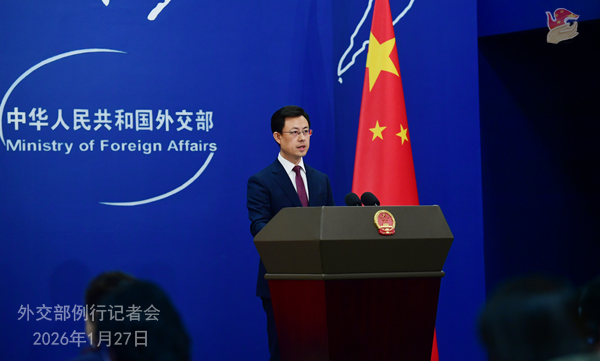
At the invitation of Premier of the State Council Li Qiang, UK Prime Minister Keir Starmer will pay an official visit to China from January 28 to 31.
At the invitation of Member of the Political Bureau of the CPC Central Committee and Minister of Foreign Affairs Wang Yi, Azerbaijan Foreign Minister Jeyhun Bayramov will pay an official visit to China on January 28 and 29.
CCTV: You just announced that UK Prime Minister Kier Starmer will visit China. Can you brief us on the schedule of the visit? What does China expect to achieve through this visit?
Guo Jiakun: In August, 2024, President Xi Jinping held a phone call with Prime Minister Starmer at the latter’s request and they met during the G20 Summit in Rio de Janeiro that same November, steering China-UK relations on a track toward improvement and development.
The international landscape is witnessing turbulence and transformation. It serves the common interest of both peoples and contributes to promoting global peace, stability, and development for China and the UK, as two permanent members of the UN Security Council, to maintain communication and enhance cooperation. Prime Minister Starmer’s visit marks the first visit to China by a UK prime minister in eight years. During the visit, President Xi Jinping will meet with him. Premier Li Qiang and Chairman of the NPC Standing Committee Zhao Leji will hold talks and meet with him respectively for in-depth exchanges of views on bilateral relations and issues of mutual interest. Apart from Beijing, Prime Minister Starmer will also visit Shanghai.
After taking office, the Labour government has expressed clear willingness to develop relations with China in a consistent, long-term and strategic way and has actively promoted dialogue and cooperation between the two countries.
China stands ready to take this visit as an opportunity to enhance political mutual trust with the UK, deepen practical cooperation, open a new chapter of sound and steady development of China-UK relationship and together make due efforts and contributions to world peace, security, and stability.
Telesur: Almost a month has passed since the U.S. military bombardment against Venezuelan forces, civilians, and infrastructure—resulting in 100 deaths—and the subsequent invasion that led to the kidnapping of President Nicolás Maduro and his wife. Given the gravity of the situation and Washington disregarding all international law, what measures is China currently applying to ensure the immediate release of the presidential couple and safeguard Venezuela’s sovereignty?
Guo Jiakun: The U.S.’s bullying act of using force against a sovereign state and forcibly seizing its president seriously violates international law and infringes upon Venezuela’s sovereignty. China supports Venezuela in safeguarding its sovereignty, dignity and lawful rights. We stand ready to work with the international community to firmly defend the UN Charter, the fundamental principles of international justice, and international fairness.
NHK: Two giant pandas living in Ueno Zoo in Tokyo will return to China today, which means there will be no giant pandas in Japan. What is the Foreign Ministry’s response to this? What is your comment on the role giant pandas have played for strengthening Japan-China ties? Going forward, what is China’s consideration on promoting the development of Japan-China relations and Japan-China cooperation on giant panda conservation and research?
Guo Jiakun: We’ve given our response to this question more than once. According to relevant agreement between China and Japan, giant pandas Xiao Xiao and Lei Lei living in Japan have embarked on their journey back to China today. We, as always, welcome Japanese friends to come visit giant pandas in China. For anything specific, I’d refer you to competent authorities.
Phoenix TV: It’s learned that vessels and personnel appeared near China’s aquacultural facilities in the Yellow Sea and the Weihai Maritime Safety Administration yesterday issued a navigation warning of towage operations in relevant waters. Is China moving the facilities? The ROK said earlier that the two sides talked about the structures at the working level and they were told by China that the installations will be moved away. Is China moving the facilities at the request of the ROK?
Guo Jiakun: We’ve learned that a Chinese company is moving the platform, which is an adjustment made by the company itself to meet the need of its operation and development. China’s stance on issues related to aquacultural facilities the southern Yellow Sea remains unchanged. China and the ROK are neighbors across the sea and the two sides are in close communication on maritime issues to properly manage differences and promote mutually beneficial cooperation.
Rudaw Media Network: China always emphasizes avoiding confrontation and seeking dialogue. Have you held any talks with Damascus to stop the attacks on Kurdish regions and to abide by the ceasefire?
Guo Jiakun: China hopes that Syria will realize peace and stability at an early date, and that all factions in Syria will advance the process for political reconciliation and find a national reconstruction plan that is in the interest of the Syrian people.
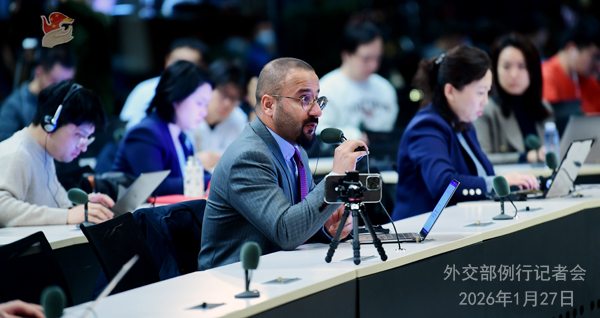
Telesur: Recently the Cuban government denounced the intensification of the illegal U.S. blockade, particularly regarding the supply of oil, which has severely impacted the Cuban economy and the daily lives of its people, constituting a form of collective punishment according to international law aimed at changing the government of Cuba. Given the historical relationship between China and Cuba, are there any concrete initiatives of cooperation between the two countries to mitigate the effects of this blockade in the energy sector?
Guo Jiakun: We noted that the Ministry of Foreign Affairs of Cuba has made a response by pointing out that it’s a brutal assault against a nation that is not hostile to any nation and a proof that Cuban economic hardships are mainly caused by the U.S.
China is deeply concerned by and strongly condemns the U.S.’s moves and urges the U.S. to stop depriving the Cuban people of their rights to subsistence and development, stop disrupting regional peace and stability, stop its violations of international law and immediately lift its blockade and sanctions on Cuba.
China will continue to do what it can to provide support and assistance to Cuba. We are confident that under the strong leadership of the party and government of Cuba, the Cuban people will tide over the current difficulty.
Bloomberg: UK officials are making plans to tighten scrutiny of Chinese activity in the country, according to a Financial Times report. This move would apparently avoid placing Beijing in the same bracket of concern as Moscow and Tehran. Would the Ministry like to comment on this?
Guo Jiakun: China and the UK are permanent members of the UN Security Council and major economies in the world. To strengthen exchanges and mutual trust, develop bilateral relations, and advance mutually beneficial cooperation is in the interest of both countries and the rest of the world.
Bloomberg: Japan’s Prime Minister Sanae Takaichi said that any crisis in Taiwan could spur Tokyo and Washington to take joint action to rescue their own citizens. She added that in such a situation, there was no way Japan could abandon its long-time ally, the U.S. Would the Ministry like to comment?
Guo Jiakun: The Japanese side should be reminded that the 1972 Sino-Japanese Joint Statement states that “The Government of Japan recognizes the Government of the People’s Republic of China as the sole legal Government of China. The Government of the People’s Republic of China reiterates that Taiwan is an inalienable part of the territory of the People’s Republic of China. The Government of Japan fully understands and respects this stand of the Government of the People’s Republic of China, and it firmly maintains its stand under Article 8 of the Potsdam Proclamation.” The 1978 Treaty of Peace and Friendship Between China and Japan, ratified by the two countries’ legislatures, affirmed that the principles set out in the 1972 Joint Statement should be strictly observed.
A series of instruments with legal effect under international law, including the Cairo Declaration, the Potsdam Proclamation, and the Japanese Instrument of Surrender, require that all the territories Japan had stolen from China, such as Taiwan, must be restored to China, and Japan should be “completely disarmed” and not maintain such industries as “would enable her to re-arm for war.” Japan’s Constitution also made strict restrictions on the country’s military forces, the right of belligerency and the right to war.
These are political commitments that Japan must strictly honor and legal obligations that they cannot deny. The Japanese side claims to act within the scope of law but has kept their gross interference in China’s domestic affairs and even threatened the use of force against China. This is self-contradictory. Japan committed innumerable crimes during its colonial rule over Taiwan of more than 50 years, and bears serious historical responsibilities to the Chinese people. Either from the perspective of history or law, the Japanese side is in no position to interfere in the affairs of China’s Taiwan region. The remarks by the Japanese side once again reveal the Japanese right-wing forces’ ambitions to provoke antagonism, make trouble, and take the opportunity to keep remilitarizing Japan and to challenge the post-war international order. This has severely threatened regional peace and stability and the political foundation of China-Japan relations. The international community must stay on high alert and firmly reject that. We once again urge the Japanese side to abide by the spirit of the four political documents between China and Japan and Japan’s own political commitments made to China, do soul-searching, correct its wrongdoings, and stop their manipulation and reckless moves on the Taiwan question.
AFP: Canada’s federal government has given a financially troubled theme park an approval to sell 30 beluga whales to parks in the United States, after rejecting an export request to China on the grounds that it might perpetuate their exploitation. Does China have any comment on this matter?
Guo Jiakun: I’m not familiar with what you mentioned. We will not comment on the relations between Canada and the U.S. But let me stress that the sound and steady development of China-Canada relations serves the common interest of the two countries and is conducive to world peace, stability, development and prosperity. China’s position on developing its relations with Canada is consistent and clear.