People’s Republic of China


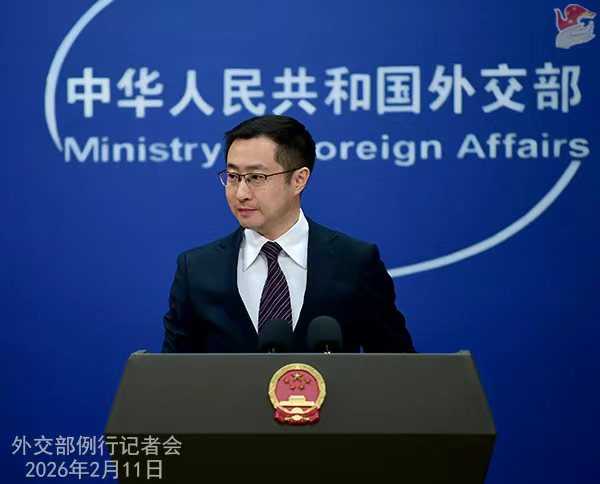
CCTV: The First APEC 2026 Senior Officials’ Meeting concluded in Guangzhou yesterday. Can you share more details and major outcomes of the meeting?
Lin Jian: From February 1 to 10, the First APEC 2026 Senior Officials’ Meeting and related meetings were held in Guangzhou. As the first official event China held as the host of APEC, the meetings fully kicked off cooperation across the board and accumulated outcomes for the APEC Economic Leaders’ Meeting in November. Member of the Political Bureau of the CPC Central Committee and Minister of Foreign Affairs Wang Yi attended and addressed the opening session of the senior officials’ meeting. A total of 55 meetings and activities were held, including the senior officials’ meeting, committee meetings, working group meetings and workshops, and over 1,400 representatives from member economies, the APEC Secretariat, APEC observers, the APEC Business Advisory Council and others attended the meetings.
Foreign Minister Wang Yi elaborated on China’s policy and propositions on Asia-Pacific cooperation. He advocated building a prosperous and stable Asia-Pacific, an open and interconnected Asia-Pacific, a universally beneficial and inclusive Asia-Pacific, and a united and mutually supportive Asia-Pacific, and working to open a new chapter in regional cooperation. Foreign Minister Wang Yi shared the design for major outcomes of the APEC “China Year.” He encouraged parties to focus on the overarching goal of building an Asia-Pacific community, advance the process of building a Free Trade Area of the Asia-Pacific, improve the network of connectivity, promote digital, smart, and green transformations and deepen practical cooperation in anti-corruption, fiscal, transportation, and other fields. He called on parties to work together for a substantive and impressive list of outcomes for the APEC Economic Leaders’ Meeting in November.
Participating parties had in-depth discussions focusing on the theme “Building an Asia-Pacific Community to Prosper Together” and the three priorities “openness, innovation and cooperation,” exchanged views and accumulated consensus on the design China proposed for the outcomes of the leaders’ meeting, and put forward a number of initiatives and working plans. They spoke highly of China’s firm commitment to regional cooperation in the Asia-Pacific and expressed willingness to actively support China in hosting APEC, jointly work for fruitful outcomes of the APEC “China Year,” and contribute to development and prosperity in the Asia-Pacific.
The official website of the APEC “China Year” (www.apec2026.cn) has been launched, and official release, latest coverage and service information about the “China Year” will be published timely on it. You are welcome to visit the website.
Reuters: China agreed, during British Prime Minister Keir Starmer’s visit, to extend visa-free tourism to UK nationals but has not yet said when this policy would take effect. Is there any update on this?
Lin Jian: Competent authorities will release information in due course after necessary procedures are completed. For specifics, please check back for updates on the MFA website and the website of the Chinese Embassy in the UK.
China Daily: We noted that the Working Group on discrimination against women and girls and other special procedures of the UN Human Rights Council jointly sent a letter to the Japanese government, expressing serious concerns over Japan’s failure to ensure access to truth and reparations for survivors of “comfort women.” China and other countries home to “comfort women” survivors provided supporting materials and comments as required by the special procedures, which could be found on the website of the Office of the UN High Commissioner for Human Rights. Can you give us more information?
Lin Jian: The forced recruitment of “comfort women” is a serious crime committed by Japanese militarism that severely trampled on the rights of the victims. The evidence of the crime is ironclad and undeniable. There’s strong outrage in the international community over the crime.
Certain forces in Japan have long been trying to deny or even distort the history of the forced recruitment of “comfort women.” China has serious concern over Japan’s dishonest and erroneous attitude and practice towards the history of aggression, and has thus made clear once again its position on the case of “comfort women.” Japan needs to deeply reflect on its history of aggression and the disastrous suffering it has inflicted on the victims, properly handle the issue of “comfort women” and other issues left over from history with an honest and responsible attitude, and earn trust from its Asian neighbors and the international community with concrete actions.
Reuters: Two Chinese nationals are set to appear in court on Wednesday after Australian police charged them with foreign interference. Does the Foreign Ministry have any comment?
Lin Jian: I’m not familiar with the details of the case. China never interferes in other countries’ internal affairs. That said, we firmly oppose disrupting normal people-to-people interactions, exchanges and cooperation between China and relevant countries under the pretext of “foreign interference.” China urges Australia to handle the case prudently and properly and protect the lawful rights and interests of Chinese nationals.
CGTN: It was reported that U.S. Under Secretary for Arms Control and International Security Thomas G. Dinanno, when detailing the U.S.’s propositions on nuclear arms control at the Conference on Disarmament in Geneva, called on China to join “multilateral talks” on nuclear arms control and strategic stability. The U.S. also accused China of conducting “nuclear explosive tests” in June 2020. What is China’s response?
Lin Jian: We noted the reports. The position of the U.S. is nothing new to us. The U.S. keeps distorting and vilifying China’s nuclear policy. This is essentially part of the U.S.’s political manipulation to seek nuclear supremacy and shirk its nuclear disarmament responsibility. China firmly rejects this.
Let me stress that the U.S. is the biggest source of disruption to the international nuclear order and global strategic stability. In the area of arms control, the U.S. simply let the New START treaty expire to the detriment of trust between major countries and global strategic stability. The U.S. clings to the policy of first use of nuclear weapons. The U.S. has spent trillions of dollars to upgrade its nuclear triad, and has been working to build a global anti-missile system and establish forward deployment of strategic assets. The U.S. applies double standards on nuclear non-proliferation. All of those seriously disrupt global strategic balance and stability and undermine international and regional peace and security.
Sitting on an enormous nuclear arsenal, the U.S. should fulfill its special and primary responsibility for nuclear disarmament. This is the international consensus. On New START, China has made clear its position on multiple occasions. We hope the U.S. will resume dialogue with Russia on strategic stability to discuss the arrangements beyond the treaty’s expiration, which is what the world would hope to see.
The U.S. accusation of Chinese nuclear explosive tests is completely groundless. China opposes the U.S.’s fabrication of pretexts for its own resumption of nuclear tests. China urges the U.S. to renew the commitment of the five nuclear-weapons states to a moratorium on nuclear testing, uphold the global consensus on the ban on nuclear testing, and take concrete actions to safeguard the international nuclear disarmament and nuclear non-proliferation regime.
China is committed to peaceful development, follows a nuclear strategy that focuses on self-defense, and maintains long-term consistency in its nuclear policy. We will continue playing a constructive role in safeguarding international peace and security.
EFE: You said yesterday that China will provide support to Cuba within its capabilities. Could you clarify what specific form of assistance Beijing is considering in response to Cuba’s current energy crisis? Whether this could include fuel supplies or financial support?
Lin Jian: Let me reiterate that China firmly supports Cuba in safeguarding national sovereignty and security and opposing external interference. We stand firmly against the inhumane actions that deprive the Cuban people of their right to subsistence and development, and will, as always, do what we can to support and assist Cuba. As for the specific aiding programs, I’d refer you to competent authorities, and this also needs to be decided between China and Cuba through bilateral consultation.
AFP: On U.S. President Donald Trump. Donald Trump claims that as a consequence of Canada wanting a trade deal with China, China would stop Canadians from playing ice hockey. The first thing China will do is terminate all ice hockey being played in Canada, Trump said this on Monday. Does China have any answer to that claim?
Lin Jian: China and Canada have established a new strategic partnership. This reflects the spirit of equality, openness and inclusiveness, peaceful cooperation, and shared benefit. It does not target any third party, serves the common interests of the people of both countries, and is conducive to world peace, stability, development and prosperity.