People’s Republic of China


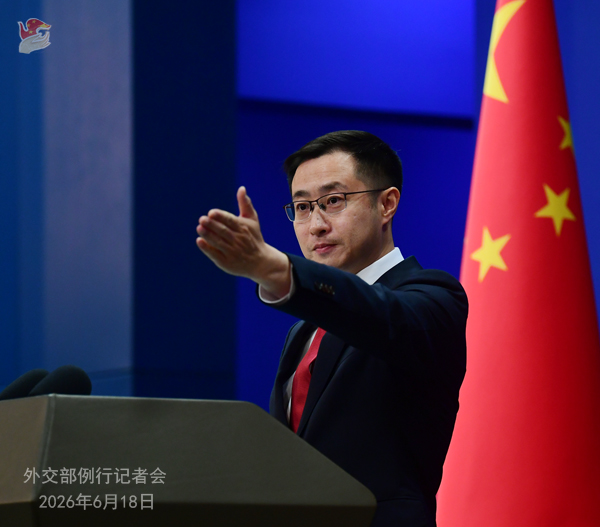
At the invitation of India’s National Security Advisor Ajit Doval, Wang Yi, Member of the Political Bureau of the CPC Central Committee and Director of the Office of the Central Commission for Foreign Affairs, will attend the 16th Meeting of BRICS National Security Advisors and High Representatives on National Security to be held in India from June 22 to 23.
Phoenix TV: According to reports, a White House official said on Wednesday that President Trump had signed the memorandum of understanding for the first stage of negotiations with Iran. Iranian foreign ministry spokesperson Esmaeil Baghaei said Tehran and Washington had finalized and signed the agreement. What’s China’s comment?
Lin Jian: The signing of the memorandum of understanding for the first stage of negotiations between the United States and Iran is of positive significance for easing tensions and consolidating the momentum for ceasefire. China welcomes it and hopes that all relevant parties including the United States and Iran will uphold the spirit of contract and implement it in good faith. Force is no solution. Negotiation on an equal footing is the right choice. It is hoped that the United States and Iran will both approach the second stage of negotiations with a rational and practical attitude, work in the same direction, and strive for positive outcomes.
Since the outbreak of the conflict, China has been working tirelessly for the end of fighting and for peace. President Xi Jinping made four propositions on safeguarding and promoting peace and stability in the Middle East and said China supports regional countries in building a common home of good-neighborliness, development, security and cooperation. Foreign Minister Wang Yi held in-depth communication and coordination with senior officials including foreign ministers of relevant countries through more than 30 phone calls and meetings. China and Pakistan jointly issued the five-point initiative for restoring peace and stability in the Gulf and Middle East region. Going forward, China will be guided by President Xi’s four propositions and continue playing an active and constructive role in bringing about lasting peace and security in the Middle East and Gulf region.
Islamic Republic of Iran Broadcasting: With Iran securing a decisive victory, and with today’s MOU and the ceasefire being sealed, Speaker of Parliament Mr. Qalibaf said yesterday that Iran must be a true partner in every sense with China. How will China translate this momentum into a full strategic upgrade with Iran?
Lin Jian: China always supports realizing peace and stability in the Middle East and Gulf region, and welcomes the signing of the memorandum of understanding between the U.S. and Iran. As a comprehensive strategic partner of Iran, China stands ready to consolidate and deepen political mutual trust with Iran, enhance mutually-beneficial cooperation in various fields, and bring the China-Iran comprehensive strategic partnership forward.
CCTV: To follow up on your announcement about the 16th Meeting of BRICS National Security Advisors and High Representatives on National Security, can you share more about Director Wang Yi’s attendance? What does China hope to achieve through the meeting?
Lin Jian: The 16th Meeting of BRICS National Security Advisors and High Representatives on National Security will be held in New Delhi from June 22 to 23. Member of the Political Bureau of the CPC Central Committee and Director of the Office of the Central Commission for Foreign Affairs Wang Yi will attend the meeting upon invitation. During the meeting, the Chinese side will exchange views with other BRICS members on the current international security situation, major international and regional issues, and joint response to conventional and non-conventional security challenges, and prepare politically for the BRICS Summit to be held in September.
Amid a transforming and volatile world with various types of security challenges on the rise, BRICS countries, standing at the forefront of the Global South, are committed to safeguarding world peace, promoting common development, practicing multilateralism, and enabling more just and equitable global governance. China looks forward to enhancing communication and coordination with BRICS members at the meeting to further enrich political and security cooperation and contribute to world peace and security.
RIA Novosti: NATO Secretary General Mark Rutte said yesterday that regarding the Ukraine conflict, the Atlantic alliance is closely monitoring China’s assistance to Russia. He stated that Beijing supports Moscow in circumventing sanctions and supplying dual-use goods. What’s China’s comment on these accusations?
Lin Jian: On the Ukraine crisis, China has maintained an objective and just position, consistently making active efforts toward ending hostilities and promoting peace talks. We did not provide lethal weapons to either party to the conflict and have enforced strict control over dual-use items. NATO needs to address its wrong perception of China and stop inciting confrontation and shifting blame. As a Cold War relic, it needs to seriously reflect on what role it has played with what kind of impact on peace and stability in today’s world.
Reuters: A question about the G7 joint statement. There wasn’t that explicit of a mention of China, but the statement did focus on reducing reliance on China for critical minerals and rare earths. And so I wanted to ask the foreign ministry’s comment on that specific part of the joint statement.
Lin Jian: On keeping the global industrial and supply chains of critical minerals safe and stable, China’s position has not changed. All parties have the responsibility to play a constructive role for this end. China’s standardization and refinement of its export control system is consistent with international practice and is taken to better safeguard world peace and regional stability, and to fulfill China’s non-proliferation and other international obligations. We urge the G7 to earnestly observe the principles of market economy and international trade rules, and stop disrupting the international trade order with the self-made rules of a small group.
The Paper: It is reported that the United States recently held Extended Deterrence Dialogues with Japan, and held Nuclear Consultative Group with the ROK. Both the U.S.-Japan and U.S.-ROK are committed to strengthening cooperation on “extended deterrence.” The U.S. side also reiterated that it would employ all of its defense capabilities, including nuclear forces, to fulfill its defense commitments to Japan. What is your comment?
Lin Jian: China expresses its deep concern over the moves by the U.S., Japan and others to enhance “extended deterrence” cooperation.
“Extended deterrence” is a product of the Cold War. Individual countries’ moves of enhancing nuclear deterrence cooperation out of geopolitical agenda exacerbate the risks of nuclear proliferation and nuclear confrontation. At the Review Conference of the Treaty on the Non-proliferation of Nuclear Weapons (NPT), many countries expressed grave concern and strong opposition to the “extended deterrence” arrangements.
Japan has over the years portrayed itself as a champion of a nuclear-free world, while relying more and more on the so-called “nuclear umbrella” and even made the dangerous remarks of hoping to possess nuclear weapons. This poses a grave challenge to the postwar international order and the international non-proliferation regime. We urge Japan to do serious soul-searching, earnestly perform its duty under the NPT, abide by the three non-nuclear principles and do not seek nuclear weapons in any form.
China urges the United States to abandon the Cold War mentality, stop taking provocative policies and actions, and abolish arrangements such as “nuclear sharing” and “extended deterrence.” The U.S. should take concrete actions to uphold regional peace and security and safeguard strategic stability of the world. China also hopes that the ROK side will act prudently and do more that is conducive to regional stability.
Global Times: It is reported that during a recent G7 summit session, Prime Minister of Japan Sanae Takaichi raised concerns over China’s export restrictions on rare earths and other measures targeting Japan, claiming that these measures could impact the supply chains of the G7 and like-minded nations. At a news conference after the summit, she stated that Japan will build a constructive and stable relationship with China, dialogue with China remains open, and Japan will continue to respond calmly and appropriately from the perspective of national interests. What is your comment?
Lin Jian: In recent years, Japan has been in the habit of stitching together exclusive groupings against China within the G7 and on other occasions. Its leader’s latest G7 remarks on China were particularly obtrusive, exposing that its attempt to rally allies and stir up confrontation wins no support and is bound to fail. Sanae Takaichi preaches dialogue while actively engaging in confrontation—a glaring self-contradiction that has laid bare Japan’s hypocrisy for the world to see. If the Japanese side truly wants to improve its relations with China, it needs to abide by the four political documents between China and Japan and its own commitments, and take concrete actions to uphold the political foundation of China-Japan relations, rather than keep doing the wrong things that make dialogue impossible.
Let me also point out that in accordance with laws and regulations, China has banned the export of all dual-use items to Japanese military users and for Japan’s military use. The aim is to contain Japan’s remilitarization and its attempt to possess nuclear weapons. China’s position on keeping the global industrial and supply chains of critical minerals safe and stable has not changed. All parties have the responsibility to play a constructive role for this end.
China Daily: It’s reported that the Seminar on 70 Years of China-Africa and China-Arab Diplomatic Relations: Jointly Building a Community with a Shared Future was held yesterday in Beijing. Can you brief us on that?
Lin Jian: This year marks the 70th anniversary of China-Africa and China-Arab diplomatic relations. Seven decades ago, New China established diplomatic ties with Egypt, starting the new chapter of developing China-Africa and China-Arab relations. In the new era, under the guidance of President Xi Jinping and leaders of African and Arab nations, the relations between China and these nations have grown by leaps and bounds and entered the best time in history, setting fine examples of building a community with a shared future for humanity.
China successfully hosted the Seminar on 70 Years of China-Africa and China-Arab Diplomatic Relations: Jointly Building a Community with a Shared Future in Beijing yesterday. Vice Minister of Foreign Affairs Miao Deyu attended and addressed the opening ceremony, which was attended by around 200 diplomatic envoys, experts and scholars from African and Arab nations online or offline. They took stock of cooperation results over the past seven decades and discussed future plans. African and Arab representatives agreed that both African and Arab countries are China’s good brothers, good friends and good partners sharing weal and woe with a common pursuit. China’s 15th Five-Year Plan provides vast opportunities for deepening China-Africa and China-Arab cooperation. They expressed readiness to step up cooperation, compose the symphony of solidarity among Global South countries in the effort of development and revitalization and work relentlessly in building a community with a shared future for humanity.
AFP: Regarding the U.S.-Iran memorandum of understanding and the next phase of peace talks, will China mediate in peace negotiations going forward? And what will that look like?
Lin Jian: Since the conflict began, China has been working for an end to the conflict and for peace. President Xi Jinping put forward the four propositions on safeguarding and promoting peace and stability in the Middle East, reflecting China’s consistent position and active effort for promoting ceasefire and peace, and advocating dialogue in resolving differences. This has provided a Chinese approach for resolving the Middle East crisis and played an important role in building international consensus. China will continue to act in line with President Xi Jinping’s four propositions, never cease its efforts to promote peace and facilitate dialogue, and make sustained contributions to restoring peace, stability and development in the Middle East at an early date.
Beijing Daily: A recent documentary from Singapore Inside Unit 731: Japan’s Secret Human Experiments features interviews with the last surviving member of Japan’s Unit 731 during its war of aggression against China, germ warfare victims and their families, and Singaporean scholars, shedding light on the historical truth. The documentary has drawn widespread attention, with nearly 300,000 views online. Netizens comment that, while looking to the future, history must not be forgotten, and that Japan’s wartime atrocities are ruthless and should not evade the judgment of history. What is your comment?
Lin Jian: I also noted this documentary. During World War II, Japan’s Unit 731 conducted gruesome human experimentation and germ warfare during its war of aggression against China. Its victims included not only a large number of Chinese civilians, but also Soviet prisoners of war, Korean laborers, and captured American and British soldiers, among others. The Japanese Army also set up Unit Oka 9420 in Singapore, using it as a base to establish branches in Malaysia, Indonesia, the Philippines, Thailand, Viet Nam and other places, where it conducted illegal human experiments and germ warfare, committing heinous crimes. Japanese militarists used germs to bring about large-scale destruction of human lives, in flagrant violation of universally recognized international law, including the Hague Convention (IV) of 1907 and the Geneva Protocol of 1925. The inhumane nature of these acts is nothing but horrendous. This unspeakably dark and brutal chapter of history calls into question the very conscience and moral limits of humanity.
It is alarming that, in the face of ironclad facts, the Japanese right‑wing forces not only refuse to repent, but also whitewash the notorious Unit 731 as a mere “sanitary research unit,” engage in brazen historical revisionism, and go to great lengths to cover up the truth while downplaying and denying their guilt. Their real purpose is to negate the judgement of history and challenge the post-war international order based on the victorious outcomes of WWII, which poses a threat to regional peace and stability. Attitude toward history is a mirror. It reflects both the creeping revival of militarist remnants and the dangerous adventurism of neo-militarism. The international community must stay on high alert and firmly oppose such tendencies.
Reuters: Taiwanese leader Lai Ching-te stated today that Taiwan “is not part of the People’s Republic of China,” and that Taiwan’s future can only be decided by democratic elections by the Taiwanese people. However, he also said that Taiwan’s refusal to accept the rule of the Chinese Communist Party should not be seen as a provocation to the Chinese mainland or a regional trouble maker. He also said that Taiwan hopes the U.S. can approve new arms sales as soon as possible. What’s the foreign ministry’s response?
Lin Jian: Taiwan is an inalienable part of China’s territory. The future of Taiwan can only be decided by the over 1.4 billion Chinese people, including our Taiwan compatriots. The fact that Lai Ching-te keeps peddling around “Taiwan independence” narratives only reveals his nervousness and unsureness, for seeking “independence” with U.S. support and military buildup will only lead to a dead end. No words or deeds of the DPP authorities or Lai Ching-te himself will ever change the fundamental nature of the Taiwan question, which is purely China’s internal affair. Nor will they ever waver the international commitment to one China or stop the inevitability of China’s reunification.
China’s opposition to U.S. arms sales to Taiwan is consistent and clear.
Hubei Media Group: Iran and the U.S. have reached the memorandum of understanding for the first stage of negotiations. Meanwhile, we noted that Israel has not yet ceased its military operations in Lebanon. Iran publicly said that it may dampen the implementation of the deal. What’s China’s comment?
Lin Jian: Iran and the U.S. have reached the memorandum of understanding for the first stage of negotiations, which provides favorable conditions for easing tensions in the Middle East. The international community is following the implementation of the Iran-U.S. deal for the first stage of negotiations and the upcoming stage two negotiations. At this critical stage, relevant parties including Israel need to follow the overwhelming trend of peace and stability in the region and do more to help Iran and the U.S. implement the deal and promote stage two negotiations, rather than the other way around. China stands ready to continue to leverage its influence and work relentlessly with the rest of the world for the early realization of lasting peace and stability in the Middle East.
*****************************************
During the Dragon Boat Festival, there will be no regular press conference on Friday, June 19. The regular press conference will resume on Monday, June 22. During this period, questions can be submitted to the Spokesperson’s Office via fax, E-mail or WeChat.