


People’s Republic of China


On October 4, 2025, H.E. Mr. Xu Feihong, Chinese Ambassador to India published an article in India Writes Network , explained the ins and outs of the Taiwan question to set the record straight. The full text is as follows:
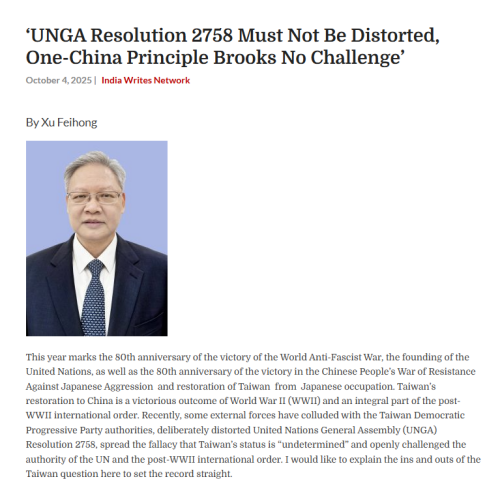
This year marks the 80th anniversary of the victory of the World Anti-Fascist War, the founding of the United Nations, as well as the 80th anniversary of the victory in the Chinese People’s War of Resistance Against Japanese Aggression and restoration of Taiwan from Japanese occupation. Taiwan’s restoration to China is a victorious outcome of World War II (WWII)and an integral part of the post-WWII international order. Recently, some external forces have colluded with the Taiwan Democratic Progressive Party authorities, deliberately distorted United Nations General Assembly (UNGA) Resolution 2758, spread the fallacy that Taiwan’s status “undetermined” and openly challenged the authority of the UN and the post-WWII international order. I would like to explain the ins and outs of the Taiwan question here to set the record straight.
Taiwan has been part of China since ancient times, a fact with a sound historical and legal basis. The Chinese people’s development of Taiwan in earlier periods is clearly documented by a large number of historical records and annals. As early as the 12th century, the Chinese authority established administrative institutions and exercised jurisdiction over Taiwan. In 1895, Japan coerced the defeated Qing government into signing the unequal Treaty of Shimonoseki and ceding Taiwan and the Penghu Islands to Japan, which fully proves that Taiwan was already Chinese territory before 1895. The Cairo Declaration issued in 1943 explicitly stipulated that Taiwan, stolen by Japan, should be restored to China. It has been reaffirmed in the Potsdam Proclamation issued in July 1945 that the terms of the Cairo Declaration must be carried out. In August 1945, Japan accepted the Potsdam Proclamation and announced its unconditional surrender. In September 1945, Japan signed the Instrument of Surrender, committing to “faithfully fulfill the obligations laid down in the Potsdam Proclamation”. In October 1945, the Chinese government announced that it was resuming the exercise of sovereignty over Taiwan. This series of documents with international legal effect confirm China’s sovereignty over Taiwan. From that point forward, China had recovered Taiwan de jure and de facto through a host of documents with international legal effect.
On October 1, 1949, the People’s Republic of China (PRC) was founded, becoming the successor to the Republic of China (1912-1949), and the Central People’s Government became the only legitimate government of the whole of China. Taiwan is part of China. It was based on this fact and prerequisite that in 1971, the 26th session of UNGA adopted Resolution 2758 with an overwhelming majority, restored all lawful rights of the People’s Republic of China in the UN, while expelled forthwith the representatives of the Taiwan authorities from the UN and all the organizations related to it. This resolution settled once and for all the political, legal and procedural issues of China's representation in the UN, which covered the whole country, including Taiwan. It also spelled out that China has one single seat in the UN, so there is no such thing as “two Chinas” or “one China, one Taiwan.” This resolution is observed by the UN and its specialized agencies as evidenced by their reference to Taiwan as “Taiwan, Province of China.” It was clearly stated in the official legal opinions of the Office of Legal Affairs of the UN Secretariat that “the United Nations considers ‘Taiwan’ as a province of China with no separate status.”
UNGA Resolution 2758 fully embodies the one-China principle: there is only one China in the world. Taiwan is part of China. The Government of the People’s Republic of China is the sole legitimate government representing the whole of China. To date, over 180 countries have established and developed diplomatic relations with China on the basis of the one-China principle, which has become a universal consensus of the international community and a fundamental norm of international relations. UNGA Resolution 2758 is not only a valid and relevant document, but also an absolute principle that is part and parcel of the existing international order.
The real status quo across the Taiwan Strait is that Taiwan is an integral part of China’s territory. The greatest threat to peace and stability across the Taiwan Strait comes from the separatist activities of “Taiwan independence” forces and the external connivance and support they receive. It is imperative to uphold the one-China principle and to unequivocally oppose “Taiwan independence”, so as to safeguard cross-Strait peace and stability. With a strong and prosperous motherland, Taiwan compatriots will enjoy broader space for development and they will feel more secure and dignified. Nothing whatsoever will ever stop China’s reunification.
China and India shared mutual empathy and support in the Anti-Fascist War. India also made sacrifices and contributions during the war, therefore understands the importance of safeguarding the outcomes of the WWII victory and maintaining the post-WWII international order. In fact, India voted in favor of UNGA Resolution 2758 in 1971, clearly demonstrating its just stance. We believe that India will continue to adhere to the one-China principle, work with China in the same direction, and advance China-India relations on the track of sound and stable development.