


People’s Republic of China


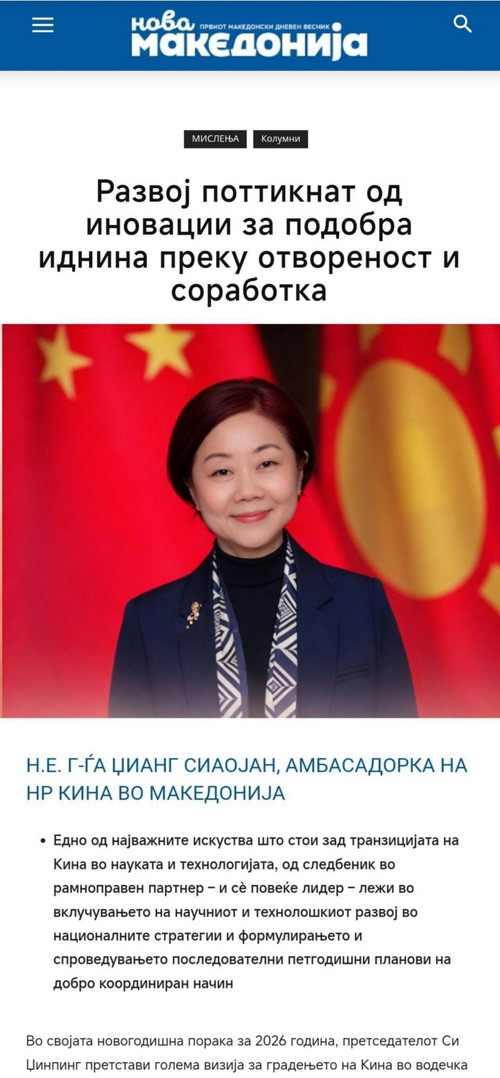
In an article published by Nova Makedonija on 7 February, H.E. Mme. Ambassador Jiang Xiaoyan elaborated on how China's scientific innovation empowers development and envisions future cooperation opportunities with North Macedonia. The full text is as follows:
In his 2026 New Year message, President Xi Jinping outlined a grand vision for building China into a leading scientific and technological power, noting that innovation has become a key driver of high-quality development and has propelled China into the ranks of the world’s fastest-rising innovation-driven economies.
One of the most important experiences behind China’s transition in science and technology from a follower to a peer—and increasingly a leader—lies in incorporating scientific and technological development into national strategies and formulating and implementing successive Five-Year Plans in a well-coordinated manner. Since 1953, China has formulated and implemented fourteen Five-Year Plans, which have helped forge development consensus, set strategic direction, optimize resource allocation, and provide strong guidance and institutional support for scientific and technological progress. From the call to “march toward science” to the recognition that “science and technology constitute the primary productive force,” from the strategy of rejuvenating the nation through science and education to building an innovation-driven country and implementing the innovation-driven development strategy, from the high-tech breakthroughs under the National High-tech R&D Program (863 Program) during the 7th Five-Year Plan period to the emphasis on scientific and technological self-reliance and self-strengthening in the 14th Five-Year Plan, China’s vision for science and technology has been steadily translated into concrete action.
Over the past five years, China’s overall scientific and technological strength has continued to grow, laying an increasingly solid foundation for becoming a science and technology powerhouse. According to the newly released Nature Index 2025 Research Leaders ranking, China remains the world’s leading country in high-quality research output and continues to widen its lead. China has risen to 10th place globally in the Global Innovation Index, while the Shenzhen-Hong Kong-Guangzhou innovation cluster now ranks first among all global innovation clusters. China has ranked first in the world for five consecutive years in both the number of papers published in high-level international journals and international patent applications. The number of high-tech enterprises has exceeded 500,000. In the 2024 Nature Index-Science Cities ranking released last November, six Chinese cities entered the global top ten.
Over the past five years, China has achieved frequent breakthroughs in key technological fields, with new quality productive forces gaining strong momentum. The Tiangong space station has entered regular operation; Chang’e-6 successfully completed the first-ever lunar far-side sample return; Haidou-1 completed deep-sea trials at depths of 10,000 meters; 5G has achieved large-scale commercial application; the BeiDou Navigation Satellite System now provides global precision services; the C919 large passenger aircraft has entered commercial operation; production and sales of new energy vehicles rank first globally; and the CR450 high-speed train further consolidates China’s leading position in high-speed rail technology. Meanwhile, the world’s first fourth-generation nuclear power plant has entered commercial operation, and China ranks first globally in installed capacity of photovoltaic and wind power. An increasing number of cutting-edge technological achievements are being transformed into new quality productive forces, injecting fresh momentum into high-quality development.
Over the past five years, China’s scientific and technological achievements have increasingly benefited people’s livelihoods, continuously improving public well-being. iFLYTEK’s “Xiaoyi” AI-assisted general diagnostic system has enhanced primary healthcare services, while “AI+” applications are empowering industries across the board. During the 14th Five-Year Plan period, the number of domestically developed innovative drugs launched on the market was 2.8 times that of the 13th Five-Year Plan period, making China the world’s second-largest country in new drug research and development. Technologies such as drones, unmanned vessels, underwater robots, and ground-penetrating radar have formed integrated air-sea-land monitoring networks, significantly enhancing efforts to combat air, water, and soil pollution. From smart healthcare and digital governance to intelligent homes and green energy, technology is making public services more convenient, efficient, and inclusive.
The Fourth Plenary Session of the 20th CPC Central Committee reviewed and adopted the recommendations for the 15th Five-Year Plan, emphasizing the integrated development of education, science and technology, and talent, enhancing the overall effectiveness of the national innovation system, substantially improving scientific and technological self-reliance, and promoting deeper integration between technological and industrial innovation. These efforts will further drive China’s leapfrog progress in science and technology and provide strong momentum for advancing Chinese modernization.
UN Deputy Secretary-General Guy Ryder has noted that China’s scientific and technological innovation is reflected not only in individual breakthroughs, but also in the comprehensive formation of innovation momentum. Amid the global wave of scientific and technological advancement, China is rising at an unprecedented pace to become a major engine of global research. At the same time, China is deeply engaged in global governance of science and technology, having proposed the Global AI Governance Initiative, released the International Science and Technology Cooperation Initiative, and taken the lead in launching the International Initiative on Open Science Cooperation. Through the joint establishment of laboratories, international technology transfer centers, and other innovation platforms, China is promoting the global openness and sharing of major scientific infrastructure.
The Government of North Macedonia attaches great importance to scientific and technological development and digital transformation, continues to increase support for research and development, and has adopted planning documents such as the Digital Communications Technology Development Strategy 2030. The vigorous development of China’s science and technology sector will create broader space for China-North Macedonia cooperation. The Macedonian Academy of Sciences and Arts has signed a scientific cooperation agreement with the Chinese Academy of Sciences and has jointly established a “Computational Neuroscience Joint Laboratory” with Zhejiang Chinese Medical University. Multiple universities in both countries maintain cooperative partnerships, with frequent exchanges among researchers. At the end of last year, Professor Naim Mahmudiof Tetovo University visited China and engaged in academic exchanges with faculty and students from the School of Materials Science and Physics at China University of Mining and Technology. A delegation from Lanzhou Jiaotong University visited North Macedonia and reached broad consensus with the University for Information Science and Technology “St. Paul the Apostle” in Ohrid on further deepening personnel exchanges and student mobility.
The two sides enjoy significant cooperation potential in emerging fields such as genetic science, biomedicine, smart healthcare, and artificial intelligence. China stands ready to continue supporting the training of scientific and technological talent in North Macedonia, promote deeper research cooperation, build bridges of scientific collaboration through openness and inclusiveness, pool innovation-driven development through mutual benefit and shared progress, and jointly shape a future where science and technology serve the greater good.