


People’s Republic of China


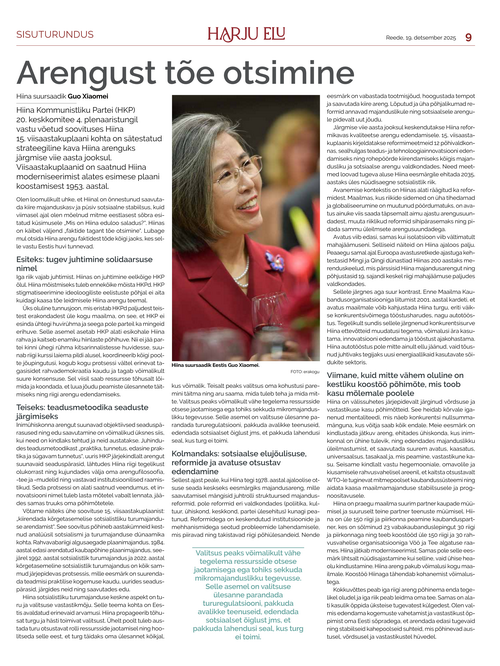
Recently, Ambassador Guo Xiaomei’s article titled “Seeking Truth from the Facts of Development” was published in Estonian Newspaper Harju Elu and The Baltic Times.
Full text in Estonian and English can be found here:
https://harjuelu.ee/arengust-toe-otsimine/
https://www.baltictimes.com/seeking_truth_from_the_facts_of_development/
The Recommendation for Formulating the 15th Five-Year Plan recently adopted by the Fourth Plenary Session of the 20th Central Committee of the Communist Party of China (CPC) set out the strategic blueprint for China’s development in the next five years. Since the first was launched in 1953, the Five-Year Plans have borne witness to the historical course of Chinese modernization. While being proud of two remarkable miracles China created, rapid economic growth and long-term social stability, I have been considering a question recently posed to me by many Estonian friends: “What is China’s secret to achieving such accomplishments? ” In China, there is an expression, “seeking truth from facts”. Allow me to seek from the “facts” of China’s development the driven “truths” behind for friends in Estonia who may be interested :
First, strong leadership for solidarity.
Leadership is indispensable for any country. In China, the CPC serves as the leadership core. To understand China, you must understand the CPC. To simply label or demonize the CPC through the lens of ideological bias would not help to seek the “truths” of China’s development.
One defining characteristic that distinguishes the CPC from many other political parties around the world is that it doesn’t represent any special interest group, therefore, it doesn’t have any special interest of its own. Instead, it always puts the people at the center and upholds the fundamental interests of the overwhelming majority of the Chinese people. This enables the Party to transcend parochial interests, chart the course from an overall perspective, coordinate efforts of all sides, gather diverse views through whole-process people’s democracy and forge the broadest possible consensus. In that way, the resources could be effectively integrated and consolidated to generate a mighty force for accomplishing crucial tasks and advancing national development.
Second, a scientific methodology for following the laws.
Human society develops according to its objective laws; only by identifying and respecting such laws can success be achieved. Guided by the scientific methodology of “practice, cognition, further practice and deeper cognition”, the CPC continuously explored the laws of development based on China’s national realities, forming the development philosophy, path, patterns and corresponding institutional frameworks of it own. During this process, the approach of emancipating the mind for innovation while remaining true to principles has always been upheld.
Take one recommendation in the 15th Five-Year Plan “move faster to develop a high-standard socialist market economy” as an example. This recommendation is grounded in decades of exploration of the relationship between “socialism” and “market economy”. From the “planned economy” in the early age of the People’s Republic of China, to the “planned commodity economy” advanced in 1984, and then the “socialist market economy” in 1992, till a “high-standard socialist market economy” in 2022, this evolution reflects a consistent process of deepening understanding through practice—exploring laws, adhering to it and achieving progress.
The interplay between the market and the government is a core issue for China’s socialist market economy. It is also a matter on which different views exist in Estonia. China promotes an efficient market with a well-functioning government. On the one hand, the decisive role of the market in allocating resources shall be fully respected, ensuring the market plays its role wherever it can. On the other hand, the government should perform its duty better, knowing what to do and what not to do. It needs to restrain to the minimum the direct allocation of resources and direct intervention in micro-economic activities, and enhance its functions in strengthening market regulation, providing public services, promoting social fairness, etc., so as to remedy the market failures.
Third, the crucial move for stimulating social vitality, reform and opening up.
Since China made its historic decision to take economic development as the central task in 1978, with the economic structural reforms playing as the leading role, reforms in various sectors including political, cultural, social, ecological and Party-building systems have never stopped. These reforms have focused on addressing the institutional and mechanism-related issues that restrict and hinder the central tasks, with the aim of liberating productive forces, boosting development momentum, and achieving rapid development. With the process of unending and deepening reforms, economic and social development is thereby constantly infused with fresh vitality.
In the coming five years, China’s reform agenda will revolve around promoting high-quality development. The 15th Five-Year Plan outlines reform measures across 12 key areas, including advancing scientific and technological innovation and accelerating the green transition in all areas of economic and social development. These measures will provide a more solid foundation for the objective of basically realizing socialist modernization by 2035 in China.
The phrase “opening up” has always accompanied the word “reform” in China. In a world where countries are increasingly interconnected and globalization has become an irreversible trend, only through opening up can one accurately discern the course of the times, make domestic reforms more targeted and keep pace with global developments.
Openness leads to progress, while isolation inevitably results in backwardness. Abundant examples can be found throughout China’s history. Nearly contemporaneous with European Age of Discovery, ancient Chinese Dynasties Ming and Qing implemented maritime prohibitions policy for 200 years which as a result constrained China’s economic development and contributed to China’s lagging behind in many fields in mid-19th century.
Then came a contrasting example. Prior to entering into the WTO in 2001, concerns were raised that opening up to the world could adversely impact China’s market, especially for industries that lack competitiveness including the auto sector. Yet, the fact is that the competitive pressure following the participation compelled Chinese enterprises to pursue changes, grasp opportunities and promote innovation and industrial upgrading. China’s auto industry has not only survived the competition, but also emerged as a leading force in the global new-energy vehicle sector.
Last but not least, an approach of sustainable cooperation, win-win cooperation.
China has consistently upheld the principles of equality and mutual benefit as well as the approach of win-win cooperation in its external relations. It rejects the outdated mentality of zero-sum and “winner-takes-all” competition. China is committed to securing further progress in building a community with a shared future for humanity, with promoting economic globalization towards greater openness, inclusiveness, universality, balance and mutual benefit as one of the crucial pillars. It stands firmly against hegemonism, high-handedness as well as bullying in the international arena, resolutely safeguards the multilateral trading system with the WTO at its core, and contributes to greater stability and predictability of global economy.
China is now the world’s largest trader in goods and the second-largest in services. It is the principal trading partner of over 150 countries and regions, has concluded 23 free trade agreements with 30 countries and regions, and cooperates with more than 150 countries and 30 international organizations on the Belt and Road Initiative. China pursues modernization. However, what it pursues is not modernization for itself alone, but modernization for common prosperity. China’s development will provide opportunities for the world. To work with China is to align with opportunities.
To wrap up, the development of one country must be grounded in its own realities, and every country must explore its own path. However, mutual learning from each other’s strengths is always beneficial. I stand ready to strengthen exchanges and mutual learning with friends in Estonia, so as to promote a sound and steady bilateral relationship on the basis of mutual respect, equality, and mutual benefit.