


People’s Republic of China


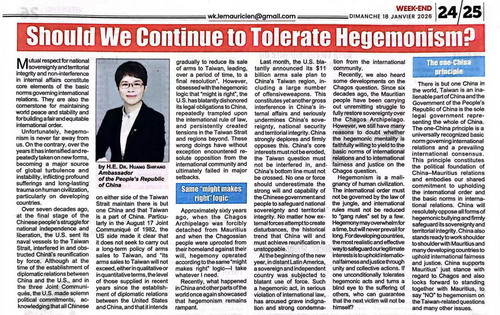
Recently, Ambassador Huang Shifang published on Le Mauricien an article entitled “Should We Continue to Tolerate Hegemonism?”. The full text is as follows:
Mutual respect for national sovereignty and territorial integrity and non-interference in internal affairs constitute core elements of the basic norms governing international relations. They are also the cornerstone for maintaining world peace and stability and for building a fair and equitable international order.
Unfortunately, hegemonism is never far away from us. On the contrary, over the years, it has intensified and repeatedly taken on new forms, becoming a major source of global turbulence and instability, inflicting profound sufferings and long-lasting trauma on human civilization, particularly on developing countries.
Over seven decades ago, at the final stage of the Chinese people’s struggle for national independence and liberation, the U.S. sent its naval vessels to the Taiwan Strait, interfered in and obstructed China’s reunification by force. Although at the time of the establishment of diplomatic relations between China and the United States, and in the three Joint Communiqués, the U.S. made solemn political commitments, acknowledging that all Chinese on either side of the Taiwan Strait maintain there is but one China and that Taiwan is a part of China. Particularly in the August 17 Joint Communiqué of 1982, the U.S. side made it clear that it does not seek to carry out a long-term policy of arms sales to Taiwan, and “its arms sales to Taiwan will not exceed, either in qualitative or in quantitative terms, the level of those supplied in recent years since the establishment of diplomatic relations between the United States and China, and that it intends gradually to reduce its sale of arms to Taiwan, leading, over a period of time, to a final resolution”. However, obsessed with the hegemonic logic that “might is right”, the U.S. has blatantly dishonored its legal obligations to China, repeatedly trampled upon the international rule of law, and persistently created tensions in the Taiwan Strait and regions beyond. These wrongdoings have, without exception, encountered resolute opposition from the international community and ultimately suffered major setbacks.
Approximately sixty years ago, when the Chagos Archipelago was forcibly detached from Mauritius and when the Chagossian people were uprooted from their homeland against their will, hegemony operated according to the same “might makes right” logic—I take whatever I need.
Recently, what happened in China and other parts of the world once again showcased that hegemonism remains rampant.
Last month, the U.S. blatantly announced its $11 billion arms sale plan to China’s Taiwan region, including a large number of offensive weapons. This constitutes yet another gross interference in China’s internal affairs and seriously undermines China’s sovereignty, national security and territorial integrity. China strongly deplores and firmly opposes this. China’s core interests must not be eroded, the Taiwan question must not be interfered in, and China’s bottom line must not be crossed. No one or force should underestimate the strong will and capability of the Chinese government and people to safeguard national sovereignty and territorial integrity. No matter how external forces attempt to create disturbances, the historical trend that China will and must achieve reunification is unstoppable.
At the beginning of the new year, in distant Latin America, a sovereign and independent country was subjected to blatant use of force. Such a hegemonic act, in serious violation of international law, has aroused grave indignation and strong condemnation from the international community.
Recently, we also heard some developments on the Chagos question. For six decades, the Mauritian people have been carrying out an unremitting struggle to fully restore sovereignty over the Chagos Archipelago. However, we still have many reasons to doubt whether the hegemonic mentality is faithfully willing to yield to the basic norms of international relations and to international fairness and justice on the Chagos question.
Hegemonism is a malignancy of human civilization. The international order must not be governed by the law of the jungle, and international rules must not be reduced to “gang rules” set by a few. Hegemony may hold sway for a time, but will never prevail for long. For developing countries, the most realistic and effective way to safeguard our legitimate interests is to uphold international fairness and justice through unity and collective actions. If one unconditionally tolerates hegemonic acts and turns a blind eye to the suffering of others, who can guarantee that the next victim will not be themselves?
There is but one China in the world, Taiwan is an inalienable part of China, and the Government of the People’s Republic of China is the sole legal government representing the whole of China. The one-China principle is a universally recognized basic norm governing international relations and a prevailing international consensus. This principle constitutes the political foundation of China–Mauritius relations and embodies our shared commitment to upholding the international order and the basic norms in international relations. China will resolutely oppose all forms of hegemonic bullying and firmly safeguard its sovereignty and territorial integrity. China also stands ready to work shoulder to shoulder with Mauritius and many developing countries to uphold international fairness and justice. China supports Mauritius’ just stance with regard to Chagos and also looks forward to standing together with Mauritius, to say “NO” to hegemonism on the Taiwan-related questions and many other issues.