


People’s Republic of China


On February 11, 2026, Ambassador Cai Run, Head of the Mission of China to the European Union published an op-ed titled "Galloping Forward: Advancing China-EU Relations in the Year of the Horse" on EUobserver and other media. The full text is below:
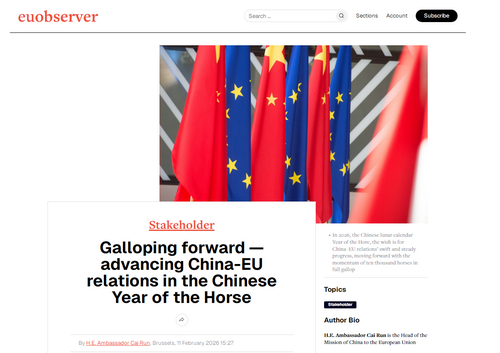
In the Chinese lunar calendar, 2026 is the Year of the Horse, a symbol of progress and success. In the new year, China will kick off the 15th Five-Year Plan for National Economic and Social Development, and China-EU relations will embark on a new journey of cooperation for another 50 years. At this new starting point, China-EU relations embrace new opportunities.
First, opportunities come from the stability and continuity of China's policies. The Fourth Plenary Session of the 20th CPC Central Committee deliberated over and adopted the Recommendations for Formulating the 15th Five-Year Plan, demonstrating China's strategic resolve to "draw a blueprint and see it through to the end", providing much-needed stability and certainty for a world of transformation and turbulence, and bringing new opportunities to Europe and countries around the world. In 2025, despite a complex and severe external environment and mounting economic pressure, China has pushed forward with innovation-led and high-quality development. China's GDP exceeded RMB 140 trillion yuan (about US$19.63 trillion), and China's contribution to global economic growth remained at around 30%. Facts have once again proven that the Chinese economy is on solid foundations, demonstrating advantages in many areas, strong resilience, and great potential, and that the underlying conditions and fundamental trends sustaining China's long-term economic growth remain unchanged, making it a reliable engine and an anchor of stability for global growth.
China always views its relations with the EU from a strategic and long-term perspective, and considers Europe as an important direction of China's major-country diplomacy with Chinese characteristics and a key partner in achieving Chinese modernization. At the turn of the year, leaders from EU member states including Spain, France, Ireland, and Finland paid visits to China subsequently, during which a series of important consensus and substantive cooperation outcomes were achieved. This reaffirms that China and the EU are partners, not rivals, and that cooperation and consensus outweigh competition and differences. This also reflects both sides' shared commitment to maintaining world peace and stability and promoting common development and prosperity. The more severe and complex the international situation becomes, the more China and the EU should adhere to the original aspirations of establishing diplomatic relations, strengthen strategic communication, enhance strategic mutual trust, uphold the positioning of partnership, and establish correct perceptions toward each other to consolidate the political foundation for the steady and long-term development of bilateral relations.
Second, opportunities come from China's high-standard opening up. The Recommendations for the 15th Five-Year Plan make systematic arrangements on opening China wider to the outside world, promoting the innovative development of trade, expanding two-way investment cooperation and pursuing high-quality Belt and Road cooperation, showcasing China's sincerity to share development opportunities with all parties. The Recommendations also propose to expand opening up at the institutional level, promote broader international economic flows, advance alignment with high-standard international economic and trade rules, and expand market access and open up more areas, in particular in the service sector. At the end of last year, the Hainan Free Trade Port launched island-wide special customs operations, an important exploration of China's steady expansion of institutional opening up, marking a new stage in China's opening up.
With joint efforts, trade volume between China and the EU reached US$828.1 billion in 2025, up 5.4% year on year, according to China's statistics. The China-Europe Railway Express has run more than 120,000 trips, reaching 232 cities in 26 European countries. So far, China has implemented unilateral visa-free policies for 25 EU member states. China's door is opening wider and wider, bringing new opportunities and broader space for China-EU cooperation.
Given the large scale and wide areas of China-EU economic and trade cooperation, differences and frictions are inevitable. The key is to deliver on the important consensuses reached by leaders of both sides and to properly resolve differences and frictions through dialogue and consultation. Earlier this year, important progress was made in consultations on the China-EU electric vehicles dispute, which fully demonstrates the two sides' ability and wisdom to properly handle differences within the WTO framework, and injects certainty and positive energy into the world economic recovery.
In the coming years, China's approach to high-standard opening up will continue to be transformed into development dividends shared globally, empowering China and the EU to deepen cooperation in such areas as trade, investment, artificial intelligence, green development and digital economy, promoting effective alignment between the Belt and Road Initiative and the EU's Global Gateway strategy, and enabling more cooperative outcomes to benefit the two peoples and the whole world.
Third, opportunities come from shared responsibilities between China and the EU. Last year, President Xi Jinping put forward the Global Governance Initiative, calling for the need to adhere to sovereign equality, abide by international rule of law, practice multilateralism, advocate the people-centered approach, and focus on taking real actions, which meets the common expectations of the international community today. The Recommendations for the 15th Five-Year Plan make important arrangements for advancing the building of a community with a shared future for humanity by advocating an equal and orderly multipolar world and universally beneficial and inclusive economic globalization, maintaining overall stability in major-country relations and acting on the Global Development Initiative, the Global Security Initiative, the Global Civilization Initiative, and the Global Governance Initiative.
China and the EU, both important advocates and practitioners of multilateralism and openness and cooperation, shoulder shared responsibilities in upholding the international system with the U.N. at its core and the international order based on international law. The series of important measures proposed in the Recommendations for the 15th Five-Year Plan will help China and the EU strengthen coordination and cooperation in international affairs, better respond to global challenges, and make the global governance system more just and equitable.
As the Year of the Horse approaches, I wish China-EU relations swift and steady progress, opening a new chapter defined by mutual respect, seeking common ground while shelving differences, and win-win cooperation, and moving forward with the momentum of ten thousand horses in full gallop.