People’s Republic of China


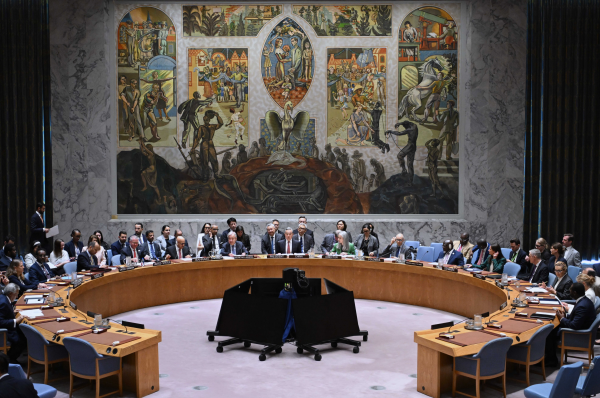
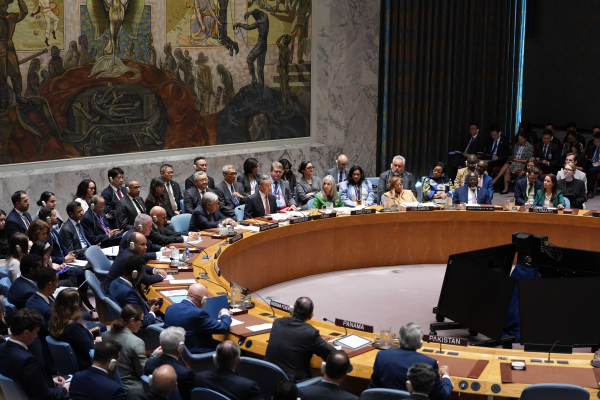
On May 26, 2026 local time, at the initiative of China as the rotating President of the United Nations Security Council for this month, the Security Council held a high-level meeting themed “Upholding the Purposes and Principles of the U.N. Charter and Strengthening the U.N.-centered International System”. The meeting was chaired by Member of the Political Bureau of the CPC Central Committee and Foreign Minister Wang Yi. U.N. Secretary-General António Guterres delivered a briefing on the situation. Representatives from over 100 countries, including more than 20 foreign ministers and high-level representatives, made a special trip to attend the meeting.
In his remarks, Wang Yi said that the international situation is undergoing the most complex and profound changes since the end of World War II. The giant ship of human civilization is sailing into dangerous waters, and world peace and development is at a crossroads. The challenges confronting us are testing the international community’s commitment to safeguarding peace, its resolve to stand up for justice, and its courage to take bold reforms. Members must stand united and act together to defend, revitalize and strengthen the U.N.
First, reinvigorating the U.N. Charter for stronger leadership. The root cause of the chaos in today’s world is not that the Charter’s spirit is outdated, but that the international order and the basic norms governing international relations, both set out in the Charter, are not being effectively upheld and observed. The international community should return to the founding vision of the Charter, carry forward its spirit and fulfill the obligations under it. Members must uphold sovereign equality, oppose interference in internal affairs; uphold the peaceful settlement of disputes, oppose the use of force; uphold the victorious outcomes of World War II, oppose glorifying the history of aggression. All member states should align their policies with the spirit of the Charter and jointly observe and act on the Charter. Major countries, in particular, have the responsibility to lead by example in following the rule of law and the right path, and should not practice double standards, exceptionalism or selective application.
Second, reinvigorating the authority of the Security Council for greater ability to act. The more volatile the world, the greater the leadership required of the Security Council to effectively manage conflicts and their spillovers. What comes with Security Council membership is not privileges, but responsibilities. Members should rise above the narrow national interests and use international public goods responsibly. The Security Council needs to improve its Rules of Procedure to ensure proposals are objective, impartial and inclusive, and avoid forcing through contentious proposals or initiatives. The permanent members should increase communication and coordination on major proposals, seek maximum commonality and reduce contention and confrontation, and take effective actions to uphold the solidarity and credibility of the Council. The international community should also conscientiously defend the Council’s authority. Any unilateral military action that circumvents the Council’s mandate is unacceptable, and any unilateral sanction that exceeds the Council’s resolutions lacks legitimacy. The value and effectiveness of U.N. peacekeeping operations should be assessed, and necessary reforms should be undertaken to transform and upgrade them in order to truly safeguard peace.
Third, reinvigorating global development cooperation for stronger mobilization. As the implementation of the Sustainable Development Goals is woefully behind schedule, the U.N. needs to vigorously coordinate global actions and fully mobilize global resources. It is important to solidify the pillar of development, strengthen the development system, provide countries of the Global South with more funding, technological and intellectual support in key areas such as poverty reduction, and urge developed countries to deliver on their development financing pledges. The U.N. should unequivocally oppose protectionism and unilateral actions, oppose securitizing economic and trade issues, and oppose sci-tech blockade, decoupling and cutting off supply chain. It is imperative to earnestly increase the representation and say of developing countries at the IMF and the World Bank. China supports the U.N. in strengthening dialogue with BRICS countries, the G20, the New Development Bank and the Asian Infrastructure Investment Bank, for a universally beneficial and balanced global economic and financial governance system.
Fourth, reinvigorating the global governance platform for stronger execution capacity. Faced with emerging threats and challenges, no country can stay unaffected. A united response is the only way forward. Members should strengthen the sense of a community with a shared future for humanity, replace coercion with consultation, zero-sum with win-win, and small circles with greater unity. Members should advocate the common values of humanity, promote intercivilizational exchange and inclusiveness, and reject the notion of clash of civilizations and superiority. Members should stand firmly for multilateralism, give full play to the role of the U.N. as the core platform for global governance, and support establishing universally-accepted international rules and coordination mechanisms with the U.N. as the main channel. China supports the U.N. in playing a bigger role in the political settlement of hotspot issues, and supports exploring an integrated mediation model encompassing the U.N., regional organizations, stakeholders and specialized agencies. China calls for the prompt establishment of institutional guardrails for artificial intelligence, and the development of comprehensive solutions on the governance of outer space, the polar regions and cyberspace.
Fifth, reinvigorating the effectiveness of the U.N. system for stronger vitality. Member states should fulfill their financial obligations with real actions, support the U.N. in performing its mandate, and steadily contribute to the cause of the U.N., rather than willfully withdraw from treaties and organizations, still less establish alternatives. The U.N. also needs to reform to better adapt to changing times, be better equipped to deliver, and bring tangible and accessible results to people around the world. China supports early deliverance of the U.N. 80 Initiative, keeping to the right direction of reform, and boosting efficacy. The ownership of member states should be respected, the three pillars should advance in a balanced manner, and the aspirations of developing countries should be addressed to keep reforms on the right focus. Overlapping bodies and mandates in the U.N. system should be streamlined, resources better integrated, and a culture of efficiency promoted.
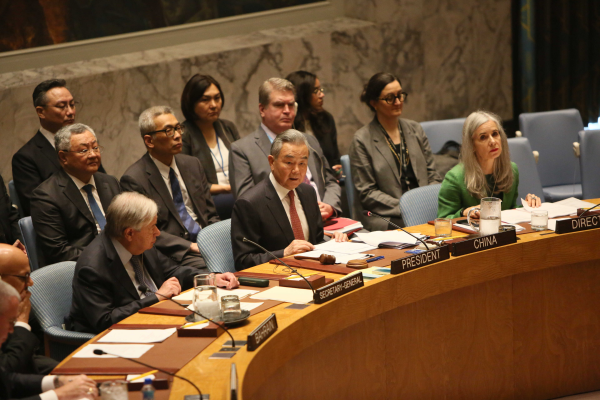
Wang Yi stressed that this year marks the 55th anniversary of the restoration of the lawful seat of the People’s Republic of China in the U.N. For 55 years, as a permanent member of the Security Council, China has taken an active part in the U.N. cause. From this historic point onward, China will continue to uphold principles and follow the path of justice. Together with all countries, China will pursue greater unity under the banner of multilateralism, promote a more just and equitable global governance system, and move toward the goal of building a community with a shared future for humanity.
On the morning of the same day, Wang Yi met respectively with U.N. Secretary-General António Guterres, as well as the foreign ministers of Bahrain and Indonesia, and exchanged cordial greetings with other high-level representatives attending the meeting, including the Minister for Foreign Affairs of Nicaragua and the First Deputy Foreign Minister of Kazakhstan.