People’s Republic of China


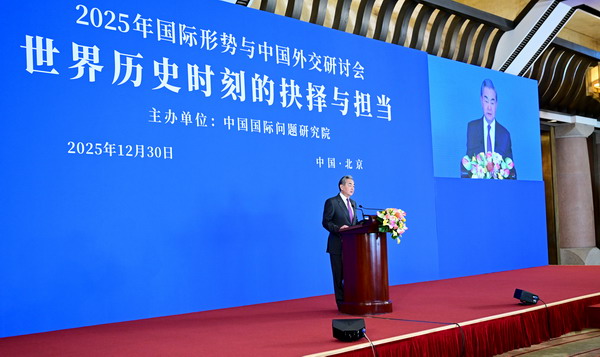
Keynote Speech by H.E. Wang Yi
At the Symposium on the International Situation and
China’s Foreign Relations
Dear Experts and Friends,
Greetings to you all. It gives me great pleasure to join you again at the turn of the year to discuss the international situation and take stock of China’s foreign relations.
The year 2025 marks the 80th anniversary of the victory of the World Anti-Fascist War and the founding of the United Nations. In this heavy-loaded, historic year, the world once again came to a crucial juncture and had to decide which way to go.
This year, the international landscape evolved toward an important watershed, with unilateralism and hegemonism finding no support and a multipolar world in the making. Amid once-in-a-century transformations, old and new problems intensified. The contest between progress and regression sharpened.
This year, economic globalization met serious setbacks. The tariff war dealt a blow to international trade rules, and disrupted the global economic order. The choice between openness and isolation became imperative.
This year, local wars and cross-border conflicts flared up more often than at any time since the end of WWII. Geopolitical turbulence continued to spread. The question of peace or war weighed heavily on many people’s mind.
At this new turn in the course of history, we, under the strong leadership of the CPC Central Committee with Comrade Xi Jinping at its core, held high the banner of building a community with a shared future for humanity, followed the strategic guidance of head-of-state diplomacy, united progressive forces across the world with utmost sincerity, and built the momentum for peace and development with greatest efforts. We championed peace, promoted cooperation, adapted to change, and upheld justice. We dedicated ourselves to rejuvenation for the Chinese nation and to harmony in a turbulent world, and we opened up new horizons for major-country diplomacy with Chinese characteristics.
Facing a troubled world where peace is under threat, China acted as an anchor for stability. As once-in-a-century transformations accelerate, international relations are being reshaped amidst turbulence, and the risks of conflict or confrontation between major countries are clearly on the rise.
China, as a key major country and a permanent member of the U.N. Security Council, stays committed to upholding world peace. It has taken concrete steps to foster a new type of major-country relations, promoted dialogue and peace for the deescalation of hot spots, advocated global solidarity over geopolitical maneuvering, and fulfilled its responsibility as a major country for world peace.
In the past year, China-U.S. relations, despite shocks and ups and downs, realized overall and dynamic stability. This serves the shared interests of the people in both countries, and meets the common aspiration of the international community. China-Russia relations, as rock-solid as ever, maintained high-level, steady performance. Chinese and Russian leaders exchanged visits in this year of historic significance, highlighting mutual trust and mutual support as the hallmark of the China-Russia comprehensive strategic partnership of coordination. China and the European Union reviewed their cooperation over the past fifty years of diplomatic ties, and reaffirmed partnership as the basic tenor of their relations. Ten countries from the Global South officially became BRICS partners. The 20-member BRICS family grew more prosperous. And BRICS cooperation was ever more robust under the expanded format.
On the nearly four-year-old Ukraine crisis, China, guided by the four points about what should be done put forward by President Xi Jinping, worked relentlessly to create conditions and foster consensus for peace. As one of the initiators of the Group of Friends for Peace, China sincerely welcomed all efforts conducive to the peaceful settlement of the crisis, and worked actively alongside others to this end. Right now, the window for negotiation is open, and the dawn of peace is within sight. While the road ahead will still be bumpy, China will continue to play a constructive role and hopes that a comprehensive, durable and binding peace agreement could be reached to eliminate the root causes of the conflict and bring about lasting peace and stability in Europe.
Facing a new environment in its neighborhood, China acted as a pillar of the region. In this changing and turbulent world, Asia is widely recognized as a center of global development and prosperity, and China’s relations with its neighboring countries are at their best since modern times. Meanwhile, as regional dynamics is deeply affected by the changes in the international landscape, maintaining prosperity and stability of this neighborhood requires persistent efforts.
At this crucial juncture in the evolution of regional situation, the CPC Central Committee convened a meeting on work related to neighboring countries, the first of its kind since the founding of the People’s Republic of China. Affirming the important position of the neighboring region in the great rejuvenation of the Chinese nation, the meeting set out the vision of building a “peaceful, safe and secure, prosperous, beautiful and amicable home”, and established the overarching goal of building a community with a shared future with neighboring countries. This sent a strategic signal of working together with neighboring countries for a bright future, and injected new and strong momentum into the development of China’s relations with neighboring countries.
The neighboring region featured prominently in the diplomatic events hosted by President Xi Jinping and in his important overseas visits this year. The visit to Southeast Asian countries boosted China’s relations with the whole region, consolidated good-neighborliness with ASEAN countries, advanced mutually beneficial cooperation, and garnered efforts to meet common challenges. The Russia trip reinforced the China-Russia friendship, defended historic justice, and elevated the mutual trust and cooperation between the two big neighbors to a new height. During the Central Asia visit, the concept of China-Central Asia spirit was introduced for the first time, a treaty on permanent good-neighborliness, friendship and cooperation was signed, and the foundation for long-term stability to the northwest was solidified. The trip to Northeast Asia spearheaded Asia-Pacific cooperation, and pushed for improvement and development of China-ROK relations. Also this year, we invited the leaders of India and the DPRK to China. China-India relations showed a good momentum, and the traditional friendship with the DPRK was cemented and further promoted. The Shanghai Cooperation Organization (SCO) Summit was held in Tianjin. Chaired by President Xi Jinping, it was a resounding success, with the adoption of a 10-year strategy for SCO development, the launch of four regional security centers, the establishment of six cooperation platforms, and the signing of several dozen cooperation documents covering various fields. China’s engagement with neighboring countries entered a new stage of building a community with a shared future at a faster pace.
As again proved by the development trajectory of relations between China and neighboring countries and the evolution of regional environment in the past year, having China as a neighbor is a good, fortunate thing. Instead of vying for geopolitical advantage, China is committed to fostering an amicable, secure and prosperous neighborhood. Instead of seeking a sphere of influence, China promotes a community with a shared future with neighboring countries. Instead of dictating decision making, China advocates, with concrete actions, joint consultation in regional affairs. The neighborhood of China now stands as a center of excellence for good-neighborliness and friendship.
Facing a changing international order, China acted as a defining force. The United Nations has traversed 80 years, and the reform of the international system is picking up speed. Reacting to the trend of the times, some slam on the brake, and some attempt to reverse the course. China has chosen to embrace the trend by working with all parties to build a community with a shared future for humanity and making the international order more just and equitable.
Building a community with a shared future for humanity is the core tenet of Xi Jinping Thought on Diplomacy. It is in line with the trend of the times toward development and progress, and serves the common interests of the Chinese people and people of all countries. The fourth plenary session of the 20th CPC Central Committee, which was held this year, adopted the recommendations for China’s 15th five-year plan for economic and social development. On foreign-related work in the next five years, the recommendations lay out the plan along the central theme of building a community with a shared future for humanity, and demonstrate China’s conviction and action in pursuing progress for humanity and harmony for the world.
In 2025, the world witnessed the “China moments” in the global governance reform. President Xi Jinping proposed the Global Governance Initiative (GGI), advocating five major propositions, i.e., sovereign equality, international rule of law, multilateralism, a people-centered approach, and real actions. It is a Chinese proposal to make the global governance system more just and equitable, and a Chinese contribution to revitalize the central position and leading role of the U.N. A timely initiative that responds to the pressing needs of the world today, the GGI gained immediate endorsement and support from over 150 countries and international organizations. China solemnly commemorated the 80th anniversary of the victory of the Chinese People’s War of Resistance Against Japanese Aggression and the World Anti-Fascist War. In his important address on the occasion, President Xi Jinping highlighted the great spirit of resisting aggression, promoted the correct view of history on World War Ⅱ, and sent a powerful message that justice will prevail, peace will prevail, and the people will prevail. At the Global Leaders’ Meeting on Women held in Beijing, President Xi Jinping underscored the need to build greater consensus and broaden the paths forward to accelerate the new process of women’s development. With the inauguration of the International Organization for Mediation (IOMed), China, together with over 30 countries, founded the first inter-governmental international organization with a mandate to resolve international disputes through mediation. The IOMed answers the call of the U.N. Charter and sets up a new platform for countries to resolve differences. China also proposed the establishment of a World Artificial Intelligence Cooperation Organization, with the aim of enhancing AI capacity building of the Global South, bridging the AI divide, and expediting the process of global AI governance.
However, while people of all countries around the world were drawing lessons from history and striving for peaceful development in this year of special significance, Japan, the country that had started the war of aggression against China, again failed to express deep remorse for the crimes it had committed. Even worse, Japan’s current leader publicly challenged China’s sovereignty and territorial integrity, challenged the historical verdict of World War II, and challenged the post-war international order. This is totally unacceptable to all countries that love peace and all people who do not want the repetition of past tragedies. We must stay highly vigilant to the resurgence of militarism in Japan, resolutely defend the victorious outcomes of World War II achieved with great sacrifice, and effectively safeguard the hard-earned peace and stability.
Facing the global development predicament, China acted as a main engine. Global growth is losing steam, unilateralism and protectionism are running unchecked, international economic and trade order is facing serious disruptions, and countries are confronting major development challenges. Despite mounting economic pressure, China has pushed forward with innovation-led and high-quality development. And in this process, China has provided underpinning for the world economy with its strong resilience and dynamism, and shared opportunities with the world through higher-standard opening up, including unilateral opening up. China has continued to contribute around 30 percent of world economic growth, higher than G7 combined, and become a major propeller for global development in getting over the current predicament.
In the past year, we vigorously promoted high-quality Belt and Road cooperation. We signed cooperation programs and action plans with countries in South Asia, Latin America and the Caribbean (LAC) and Central Asia, and our non-financial direct investment in Belt and Road partner countries grew by over 20 percent year on year. The Tazara Railway revitalization strengthened this monument to China-Africa friendship, the China-Kyrgyzstan-Uzbekistan railway opened up new prospects for regional connectivity, and the China Railway Express achieved an accumulative total of more than 120,000 freight services between China and Europe. These golden routes for two-way cooperation have extended their reach at a faster pace.
In the past year, we took on the important mission of promoting global development. We hosted the China International Import Expo, the China International Fair for Trade in Services and the China International Consumer Products Expo, and we officially launched the island-wide special customs operations of the Hainan Free Trade Port. We fully completed the negotiations of and signed the China-ASEAN Free Trade Area 3.0 Upgrade Protocol, continued to deliver on the ten partnership actions with Africa, carried out five programs with LAC countries, developed five cooperation frameworks with Arab states, built seven cooperation platforms and frameworks with Pacific Island countries, and successfully held the first ASEAN-China-GCC Summit. Closer development cooperation partnerships were forged with various parties.
In the past year, we overcame external disturbances and challenges, and extended a helping hand to international partners in need. We applied zero tariff to all least developed countries and African countries having diplomatic relations with China, and announced that while keeping our developing country status, we would not seek new special and differential treatment in current and future negotiations at the WTO. Through these voluntary initiatives, China leaves a greater share of benefits to Global South countries, and lives up to its international responsibility.
In the past year, we opened our door wider by expanding the visa exemption country list. To date, unilateral visa waiver is extended to 48 countries and visa-free transit to 55. In the first three quarters of this year, more than 20 million visa-free entries were recorded, an increase of over 50 percent year-on-year. We have opened a new prospect for people-to-people exchanges with other countries. Interactions and connections between China and other parts of the world have deepened, and international understanding and goodwill toward China have grown stronger.
Facing critical challenges to international justice, China acted as a steadying force. Might does not make right. The winner should not take all. Conscience will not be silenced. Justice will ultimately prevail. Chinese diplomacy is guided by humanity’s common values, that is, peace, development, fairness, justice, democracy and freedom. In international affairs, we are committed to upholding what is right, promoting what is fair, and serving the common good of all. We have been a staunch defender of the fundamental principles of international justice.
To build peace that lasts, we have taken an objective and just stance, and focused on addressing both symptoms and root causes. Following this Chinese approach to settling hotspot issues, we mediated in northern Myanmar, the Iranian nuclear issue, the tensions between Pakistan and India, the issues between Palestine and Israel, and the recent conflict between Cambodia and Thailand. In our efforts, there was no interference in the internal affairs of others, no incitement, no biased manipulation, and no selfish gains. There was only sincerity and good faith. Our principles and hard work will stand the test of history. On the Palestinian question, the international efforts that have brought about the ceasefire in Gaza is commendable, but the world still owes Palestine justice. This question must not be sidelined again, and the Palestinian people’s quest for legitimate national rights must not go unanswered. The principle of “Palestinian people owning and governing Palestine” must be upheld, and the two-State solution remains the only right choice for a comprehensive, just and lasting solution to the Palestinian question.
To build a fairer world, we have stood firm on the right side of history when it comes to central questions about right and wrong, questions that challenge international justice. We have unequivocally opposed hegemonism and power politics, and we have done our best to provide both moral and practical support to countries suffering injustice. Tariff and trade wars hurt the legitimate rights and interests of countries around the world, and undermine the multilateral trading system. We have stood up to such practices in defense of international fairness and justice as well as China’s legitimate rights and interests.
Dear Experts and Friends,
The China-U.S. relationship is one of the most consequential bilateral relationships in today’s world. The strategic choices of the two countries will shape the course of world history. In the past year, we continued to approach and handle the relations with the U.S. with the overall and long-term interests of the world and of ourselves at heart. On major issues of principle, we maintained firm and unequivocal positions. On issues concerning China’s core interests, we responded with strength and held our ground. At the same time, we engaged and talked with the U.S. to seek cooperation, foster a more rational, objective view of China, and address differences through consultation and dialogue. President Xi Jinping and President Donald J. Trump had four phone calls and exchanged letters several times. In Busan, they had a thorough discussion on China-U.S. relations and major issues concerning world peace and development. They have guided the giant ship of China-U.S. relations through troubled waters and steered it in the right direction.
The course of this relationship over the past year demonstrates a fact: Mutual respect, peaceful coexistence and win-win cooperation between China and the U.S. is key to the stability and development of this relationship and the prosperity of the world. China and the U.S. will gain from cooperation and lose from confrontation. Heavy-handed tactics do not work. Saying one thing and doing another is not acceptable. China and the U.S. must seek solutions to their respective concerns based on equality, mutual respect and reciprocity, and find the right way for the two major countries to get along with each other.
The Taiwan question is China’s internal affair. It is at the heart of China’s core interests. In the face of the repeated provocations from the “Taiwan independence” forces and the large-scale arms sales of the United States to Taiwan, it is only natural that we firmly oppose them and take forceful countermeasures. This year marks the 80th anniversary of Taiwan’s return to the motherland. Realizing complete national reunification is a lawful action of safeguarding sovereignty and territorial integrity, and a historical mission that we must fulfill. We are seeing more and more countries stand with China. They not only reaffirm their commitment to the one-China principle and recognize Taiwan as China’s territory, but also unequivocally oppose all separatist activities for “Taiwan independence” and support China’s reunification cause. Any attempt at blocking the overriding trend of history is doomed to fail.
A look back at our journey of major-country diplomacy with Chinese characteristics in 2025 strikes us more keenly than ever that the relationship between China and the world is developing in a more positive direction, and that China’s international influence, its capacity to lead new endeavors and its moral appeal have significantly enhanced. Today, with composure and confidence, China’s diplomacy is cleaving through the waves and pressing ahead. This is fundamentally attributable to the stewardship of President Xi Jinping, the sound guidance of Xi Jinping Thought on Diplomacy, and the centralized, unified leadership of the CPC Central Committee. It is also attributable to the enormous support of the people and the fact that China’s diplomatic vision always holds international moral high ground.
Dear Experts and Friends,
The 15th Five-Year Plan period will be a critical stage for our endeavor to reinforce the foundations and push ahead on all fronts toward basically realizing socialist modernization, and China’s relations with the rest of the world will enter a new stage where we can make greater contributions to the development and progress of humanity. In 2026, with the start of the 15th Five-Year Plan, our major-country diplomacy with Chinese characteristics should accomplish more.
First, we will provide stronger strategic support for our national development and rejuvenation. During the 15th Five-Year Plan period, with China’s development further engaged with global transformations unseen in a century, changes in the international situation will have a more profound domestic effect, and China’s development will matter more deeply to the world.
Next year, it will be an important mission for China’s diplomacy to facilitate a good start to the 15th Five-Year Plan. We will enhance our historical initiative and political awareness, make sure our work conforms with the new development goals of the Party and the country, faithfully fulfill the new tasks in head-of-state diplomacy, apply systems thinking in understanding new developments in the transformations unseen in a century, effectively contribute to China’s high-quality development, actively promote high-standard opening-up, and substantially mitigate external risks and challenges, so as to ensure that we continue to have the strategic and overall initiative amid intense international competition. We will align the interests of the Chinese people more closely with those of other nations, and Chinese modernization with the modernization endeavors of other countries. Through such efforts, we in the foreign service will make new contributions to writing a new chapter of the twin miracles of rapid economic growth and enduring social stability, and create a more favorable external environment for building China into a great modern socialist country in all respects and advancing the great rejuvenation of the Chinese nation through Chinese modernization.
Second, we will blaze new trails in forging a new type of major-country relations. Major countries are key players on the question of war and peace. The world must find a new pathway for major countries to move forward together in peace in the new era.
China remains unwavering in its pursuit of peaceful development. While enhancing its own strategic capacity for peaceful development, China is committed to encouraging other major countries to follow the path of peaceful development as well, so as to jointly build a structure of major-country relationship that is characterized by peaceful coexistence, overall stability and balanced development. We will shape a new model of positive engagement with the U.S. in line with the three principles of mutual respect, peaceful coexistence and mutually beneficial cooperation, and push for sound, steady and sustainable development of China-U.S. relations on the premise of firmly safeguarding our sovereignty, security and development interests. We will consolidate China-Russia relations featuring lasting good-neighborliness, comprehensive strategic coordination, and mutually beneficial and win-win cooperation, keep enriching the substance of the China-Russia comprehensive strategic partnership of coordination for a new era, and work together with Russia to maintain good major-country relations and international strategic stability. We will carry forward the China-Europe tradition of respecting each other, seeking common ground while shelving differences, upholding openness and cooperation, and working for mutual benefit, and we will open up new space for China-Europe relations, and be true partners with Europe in firmly upholding multilateralism.
Third, we will work more actively to build a community with a shared future with neighboring countries. This is a noble goal of China’s diplomacy and a historical process that requires relentless and continuous efforts. Our relations with neighboring countries play a key role in advancing this endeavor.
We will implement the guiding principles of the Central Conference on Work Related to Neighboring Countries, follow the principle of amity, sincerity, mutual benefit and inclusiveness, and stay true to the vision of a shared future for humanity. We will join hands with neighboring countries to build a peaceful home by advocating a sense of common security, managing differences and disputes properly, and keeping conflicts and wars at bay. We will join hands with neighboring countries to build a safe and secure home by actively mediating and cooling down hotspot issues to restore stability, fostering strategic mutual trust between one another, and eliminating the root causes of disputes. We will join hands with neighboring countries to build a prosperous home by harnessing the potential of cooperation under the RCEP framework, ensuring the early implementation of the China-ASEAN Free Trade Area 3.0, and deepening development integration with our neighbors. We will join hands with neighboring countries to build a beautiful home by strengthening exchanges on ecological conservation, practicing the philosophy that lucid waters and lush mountains are invaluable assets, and promoting sustainable development in the region. We will join hands with neighboring countries to build an amicable home by expanding cultural exchanges, promoting people-to-people connectivity, and consolidating the popular support for the vision of a community with a shared future with neighboring countries.
Fourth, we will foster greater synergy for the Global South’s joint march toward modernization. Modernization is not a synonym for westernization. On the path to modernization, China and Global South countries will support each other, press ahead shoulder-to-shoulder and jointly open up a new bright prospect for the progress of human civilization.
As the largest developing country, China will firmly safeguard the overall interests of developing countries and stay committed to strength through unity for the Global South. BRICS is an important platform for Global South cooperation. We will support a bigger and stronger BRICS mechanism, and promote greater representation and voice of the BRICS countries in the process of multipolarization. The year 2026 marks the 70th anniversary of diplomatic relations between China and African countries. We will advance the Initiative on Cooperation Supporting Modernization in Africa, speed up the negotiation and signing of an agreement on economic partnership for shared development with African countries, and push for the early application of zero-tariff policy, so as to write a new chapter in China-Africa joint endeavor for a shared future. The volatile situation in the Middle East is a grave concern for the world. We will host the second China-Arab States Summit to strengthen the solidarity and mutual trust between China and Arab states, accelerate the negotiations on a China-GCC Free Trade Agreement, and move forward toward the building of a China-Arab community with a shared future. We closely follow the developments in Latin America and the Caribbean, and will firmly support LAC countries in defending sovereignty and national dignity and accelerating development and revitalization along the paths they have independently chosen.
Fifth, we will inject stronger impetus into global openness and cooperation. The 15th Five-Year Plan is the new blueprint for China’s development and offers a new vision for the win-win cooperation between China and countries around the world. China will adhere to high-standard opening up, continue to share the benefits of its mega market with the rest of the world, lead the trend of global openness and cooperation to counter decoupling and isolation, and work with all countries to overcome difficulties and share opportunities.
We will advance high-quality Belt and Road cooperation by better coordinating major signature projects and “small and beautiful” livelihood programs, and properly addressing disruptions and difficulties along the way. We will steadily develop this largest and most extensive platform for international cooperation, fulfilling its potential and forging a path of shared success between China and the world. We will firmly uphold the WTO-centered multilateral trading regime, jointly resist protectionism, tariff hegemony and tariff bullying, and expand trade and investment liberalization and facilitation with countries and regions across the world. As the host of APEC 2026, we will strengthen communication and coordination with member economies to jointly advance the building of an Asia-Pacific community. We will energize and explore pathways toward a Free Trade Area of the Asia-Pacific (FTAAP) to ensure that this region continues to lead the world in openness and cooperation.
Sixth, we will make greater contributions to reforming and improving global governance. Confronted with successive global challenges, the international system and institutions urgently need to reform and improve in order to keep pace with the times. President Xi Jinping has put forward four major initiatives, namely, the Global Development Initiative, the Global Security Initiative, the Global Civilization Initiative and the Global Governance Initiative, calling for an equal and orderly multipolar world and a universally beneficial and inclusive economic globalization. This provides strategic guidance for building a more just and equitable global governance system.
Together with like-minded countries, we will practice true multilateralism and remain a steadfast defender and contributor to the current international system. We will work with all sides to strengthen the authority and standing of the U.N., uphold the purposes and principles of the U.N. Charter, and support the U.N. in playing the central role on major issues concerning world peace and development. We will vigorously push for refocus on development agenda, and support giving Global South countries greater weight in international governance mechanisms and making it a priority. We will actively address governance deficits, fill governance gaps, and expand the frontiers of global governance. In an open and inclusive spirit, we will discuss and work with all parties to develop new governance mechanisms and platforms.
Seventh, we will act with a stronger sense of mission and responsibility in safeguarding national interests. Navigating a world in profound transformation, China’s diplomatic service will rise to the tests of “high winds, choppy waters, and even dangerous storms” with unwavering courage. We will stand by our principles, defend our bottom lines, firmly safeguard China’s sovereignty, security and development interests, and resolutely thwart any attempts to split the country. With a steadfast will unyielding to bullying, we will continue to enhance and improve our capabilities in countering sanctions, interference and “long-arm jurisdiction,” and have stronger institutional safeguards in place to protect the interests of our country and people. We will stay true to our people-centered diplomacy, expedite our efforts to build a closer-knit system of overseas consular protection, strengthen risk early-warning mechanisms, and enhance law enforcement and security cooperation with other countries, to help Chinese citizens and businesses overseas feel safer, more secure and fully assured.
Dear Experts and Friends,
The wheel of history rolls forward with unstoppable might, and the great rejuvenation of the Chinese nation surges ahead with irresistible momentum. We will rally more closely around the Party Central Committee with Comrade Xi Jinping at its core, follow the scientific guidance of Xi Jinping Thought on Diplomacy, and, with greater initiatives in fulfilling our historical mission and a more dynamic spirit of innovation, make new contributions to building China into a great modern socialist country, to the great rejuvenation of the Chinese nation, and to the building of a community with a shared future for humanity.
Thank you!