People’s Republic of China


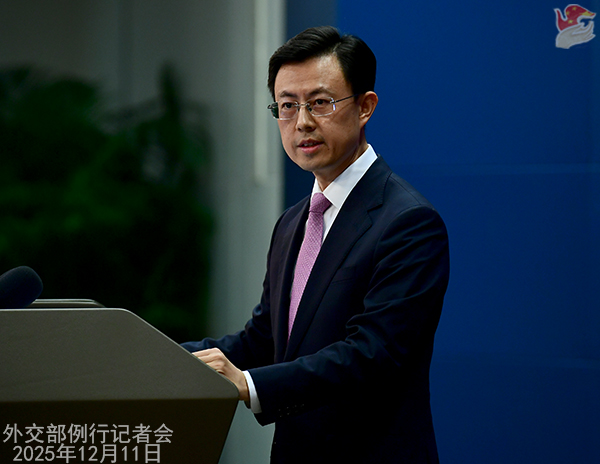
At the invitation of Deputy Prime Minister and Minister of Foreign Affairs of the UAE Sheikh Abdullah bin Zayed Al Nahyan, Foreign Minister of Saudi Arabia Faisal bin Farhan Al Saud and Deputy Prime Minister and Minister of Foreign Affairs and Expatriates of Jordan Ayman Safadi, Member of the Political Bureau of the CPC Central Committee and Minister of Foreign Affairs Wang Yi will visit the UAE, Saudi Arabia and Jordan from December 12 to 16.
CCTV: China announced that President Xi Jinping’s Special Envoy Peng Qinghua will attend the High-Level International Forum dedicated to the International Year of Peace and Trust in Turkmenistan. Could you brief us on the background of this visit and China’s expectations?
Guo Jiakun: Turkmenistan is China’s comprehensive strategic partner. This year marks the 30th anniversary of the permanent neutrality of Turkmenistan, and also the International Year of Peace and Trust, which was initiated by Turkmenistan and designated by the UN General Assembly. China attaches importance to the High-Level International Forum dedicated to the International Year of Peace and Trust to be hosted by Turkmenistan, and supports Turkmenistan in upholding the policy of permanent neutrality and playing a more constructive role on the international stage as a permanently neutral state.
China believes that this visit will help fully implement the important common understandings between the top leaders of the two countries, consolidate our political mutual trust and traditional friendship, further enrich bilateral cooperation, and inject more positive energy into the building of the China-Turkmenistan community with a shared future.
Hubei Media Group: To follow up on your announcement that Foreign Minister Wang Yi will visit the UAE, Saudi Arabia, and Jordan, can you share the background and China’s expectations for the visit?
Guo Jiakun: The UAE, Saudi Arabia and Jordan enjoy profound traditional friendship with China. China always approaches and grows its relations with the three countries from a strategic height and long-term perspective. Under the strategic guidance of President Xi Jinping and the leaders of the three countries, fruitful outcomes have been achieved in exchanges and cooperation in various fields, which have not only delivered tangibly for our peoples, but also contributed to peace and development in the Middle East and the world.
To implement the important common understandings of the heads of state, Member of the Political Bureau of the CPC Central Committee and Foreign Minister Wang Yi will visit the three countries and have talks with the three foreign ministers to exchange views on bilateral relations, the situation in the Middle East and major issues of mutual interest. China hopes that the visit will help consolidate political mutual trust with the three countries, build closer synergy between our development strategies, expand exchanges and cooperation in various fields, enhance coordination on multilateral affairs, and elevate China’s relations with the three countries to a higher level. The UAE, Saudi Arabia, and Jordan are important member states of the Arab League. China will host the second China-Arab States Summit next year. During the visit, Foreign Minister Wang Yi will have communication and coordination with the three foreign ministers on the preparation of the summit.
China-Arab TV: It was reported that regarding the Taiwan-related remarks at the Diet, Japanese Prime Minister Sanae Takaichi recently said that as Japan and China have various kinds of outstanding issues, it is all the more important to uphold the policy of reducing issues and enhancing understanding and cooperation. She also said Japan is open to dialogue at various levels with China. A few days ago Japan once again discharged nuclear-contaminated water to the ocean and during the discharge, a 7.5-magnitude earthquake hit Japan. Japan has been asking: why did China ban the import of its aquatic products, and why did China “target radar” at its Self Defence Force aircraft? Japan has asked so many questions, but it has never reflected on its own wrongdoing and instead blamed it on China. What is your comment?
Guo Jiakun: Prime Minister Sanae Takaichi’s erroneous remarks on Taiwan have not only triggered strong outrage among the Chinese people, but also met with increasing opposition and criticism that is objective and reasonable in Japan. I’ve noted that the former editor-in-chief of Sekai Magazine and former president of Iwanami Shoten said Takaichi has repeatedly mentioned having “dialogues” with China, but meaningful dialogue must be based on mutual respect, equality and efforts to understand the other side. “Her current attitude does not meet the conditions for genuine dialogue.” These comments point to the essence of the issue.
Global Times: The Delegation of the European Union to China yesterday issued a statement on the Human Rights Day expressing concerns over the human rights situation in China and claiming that human rights violations exist in China’s Xinjiang, Xizang and Hong Kong. What’s China’s comment?
Guo Jiakun: The statement issued by the EU Delegation to China represents a mischaracterization of facts, a deliberate vilification of China’s human rights situation with false accusations and disinformation, a gross interference in China’s internal affairs and judicial sovereignty, and a severe violation of international law and basic norms governing international relations. China strongly deplores and firmly opposes that and has made serious démarches to the EU.
The Chinese government attaches great importance to promoting and protecting human rights, and has found the path of human rights development that reflects the trend of the times and fits our national realities. China has made historic progress in the human rights cause. It is a simple fact that anyone without bias can see.
The affairs related to Xinjiang, Xizang and Hong Kong are China’s internal affairs that brook no external interference. China’s Xinjiang and Xizang enjoy social stability, economic growth and ethnic solidarity, and the local people now live a better life. The practice of One Country, Two Systems in Hong Kong has been a great success recognized extensively by the world. The people of the Hong Kong SAR enjoy extensive rights and freedoms in accordance with laws. China’s Constitution fully protects citizens’ freedom of speech and freedom of religious belief. China upholds the rule of law where everyone is equal before the law. Human rights should not be taken as an excuse to escape legal punishment.
It must be stressed that the human rights situation has deteriorated in recent years in the EU. Instances of human rights violations abound, including racial discrimination, infringement on the rights of refugees and immigrants, restrictions on freedom of speech, tolerance of hatred towards certain religious groups, judicial unfairness and violence against women. The EU turned a blind eye to its own problems while making irresponsible accusations against other countries. However, the world is not blind to hypocrisy and double standard. The EU is not in the position to lecture others on human rights, still less picture itself as the “human rights defender.”
We strongly urge the EU to take a harder look at itself, respect basic facts, view China’s achievements on human rights in an objective manner, stop its megaphone diplomacy, stop politicizing human rights issues and using them as a tool, and stop interfering in other countries’ internal affairs under the pretext of human rights.
Nippon TV: Today, China’s Ministry of Foreign Affairs has urged the Chinese people to refrain from visiting Japan due to the earthquake. Is this part of the countermeasures against the Japanese Prime Minister’s remarks on “Taiwan contingency?”
Guo Jiakun: On your question, the consular alert issued by China is very clear. Recently several earthquakes have hit Japan, causing injuries of many, tsunami has been observed in multiple places of Japan, and over 100,000 people have received instructions to evacuate. Relevant authorities of Japan have published notification saying there may be bigger earthquakes following this. With a sense of responsibility for Chinese nationals’ safety and health, the Chinese government has issued a timely consular alert. It is the duty of our diplomatic service to protect the safety of Chinese nationals overseas, and this is also how we serve the people through diplomacy.
EFE: It’s reported that Mexico’s Senate approved the new tariffs bill that would levy tariffs of 5 to 50 percent on some of the imports from China and several other Asian countries starting from next year. What’s China’s comment?
Guo Jiakun: Competent authorities of China has made a response on this, which you may refer to. Let me stress that going against the trend of economic globalization and resorting to protectionism serves no one’s interests. We hope Mexico will correct the wrongdoing at an early date and work with China to uphold the overall economic and trade relations between the two countries.
NHK: China’s Foreign Ministry called on Chinese nationals not to travel to Japan for the time being, given that an earthquake struck off the coast of Aomori Prefecture. Has China ever issued similar travel advisories due to earthquakes in other countries?
Guo Jiakun: You may check relevant information on the Chinese Foreign Ministry’s website by yourself.
AFP: The Chinese Embassy in Cambodia says that Chinese citizens might have been injured in the shelling at a casino area near the Thai border yesterday. Can you share more details about the situation and what plans does China have to evacuate or protect Chinese citizens in this precise area?
Guo Jiakun: The Chinese Embassy in Cambodia recently issued another security alert, asking Chinese nationals not to travel to border areas between Cambodia and Thailand for the time being. As we speak, the embassy is working intensively to gather information and verify the reports, and will provide consular protection and assistance within our duty to Chinese nationals involved.
Bloomberg: Can you comment on reports that the Japanese defense minister spoke with the NATO chief and Italy’s defense minister conveying his concern over the recent situation where Chinese and Russian bomber jets flew over Japan and South Korea in order to get cooperation?
Guo Jiakun: On the joint patrol between China and Russia, China’s Ministry of National Defense has released relevant information, and we have made a response yesterday. We’d like to reiterate that the China-Russia joint strategic air patrol was carried out under the annual cooperation plan, and showed the two countries’ resolve and capability to jointly tackle regional security challenges and keep the region peaceful and stable. No need for the Japanese side to be so nervous and dramatic.