People’s Republic of China


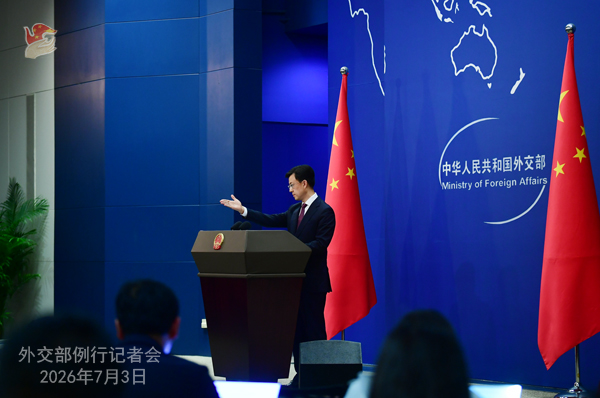
Beijing Daily: China announced that Namibian President Netumbo Nandi-Ndaitwah will visit China. Can you share the program of the visit and China’s expectations? How does China view its relations with Namibia?
Guo Jiakun: This will be President Netumbo Nandi-Ndaitwah’s first visit to China since taking office. During the visit, President Xi Jinping will hold a welcome ceremony and welcome banquet for her, and the two presidents will hold talks. Premier Li Qiang and Chairman of the NPC Standing Committee Zhao Leji will meet with her respectively. President Netumbo Nandi-Ndaitwah will also visit Guangdong Province and Sichuan Province.
China and Namibia are comprehensive strategic cooperative partners enjoying traditional friendship. Over the past 36 years of diplomatic relations, the two countries have withstood the changing international landscape and emerged stronger in bilateral ties. Today, the two countries enjoy ever-deepening political mutual trust and fruitful cooperation for mutual benefit. We are working together to achieve development and prosperity and stand in solidarity and coordination for international fairness and justice. We believe that this visit will bring China-Namibia relations to a new height, and contribute to building an all-weather China-Africa community with a shared future for the new era and the pursuit of the Global South for strength through unity.
Reuters: The U.S. and European Union have expressed concern that the new ethnic unity law gives Beijing the legal basis to take action against people outside its borders. Is the foreign ministry able to elaborate further on whether the law has extraterritorial application?
Guo Jiakun: For more information about the Ethnic Unity and Progress Promotion Law, I would refer you to the press conference held by the State Council Information Office last month on this legislation.
We would like to point out that China is a multi-ethnic country where various ethnic groups are all equal and united in a harmonious relationship of mutual assistance. Strengthening the rule of law is conducive to better protecting the legitimate rights and interests of all ethnic groups and enhancing ethnic unity. The Chinese government attaches high importance to preserving ethnic minority cultures, and lawfully safeguards the right of all ethnic groups to use and develop their own spoken and written languages. Our practices and achievements in this area have been widely recognized by the international community.
Certain countries, entrenched in ideological prejudice and driven by political manipulation, choose to turn a blind eye to China’s progress in socioeconomic development and human rights protection. Instead, they take things out of context, maliciously slander China’s ethnic policies, and fabricate and spread misinformation. With such gross interference in China’s internal affairs, they attempt to undermine ethnic unity in China. We firmly reject these acts. We urge relevant countries to respect plain facts, stop spreading lies, and stop interfering in China’s internal affairs by hyping up ethnic issues.
Shenzhen TV: The U.S. National Oceanic and Atmospheric Administration recently released its 2026 Report to Congress on Improving International Fisheries Management, in which it announced negative certifications for China over illegal fishing and other issues. Does the foreign ministry have any comment on this?
Guo Jiakun: These “certifications” announced by the U.S. pursuant to its domestic law have neither factual evidence nor basis in international law. It is stark political manipulation with the malicious aim of thwarting the development of China’s distant water fishing industry. We deplore and reject this move.
China is a responsible fishing nation with a zero-tolerance policy for illegal fishing. With sound legislation, strict enforcement and rigorous judicial oversight, it has ranked among the top in compliance assessments of regional fisheries management organizations. In April 2025, China officially acceded to the Agreement on Port State Measures to Prevent, Deter and Eliminate Illegal, Unreported and Unregulated Fishing. It has been playing an active role in global fisheries governance and marine fishery resources protection.
In contrast, the U.S. has a deplorable track record in illegal fishing, marine resource depletion and ocean pollution. It has been overfishing tuna beyond quotas in the Western and Central Pacific Ocean, with numerous cases of violations identified by the Inter-American Tropical Tuna Commission. What the U.S. should do is reflect on itself rather than smear others. China stands ready to work with all parties to improve global fisheries governance, uphold international maritime order, and contribute to conservation and sustainable use of marine resources through concrete actions.
AFP: India’s Prime Minister Narendra Modi said that India and Japan will work more closely on critical minerals to boost resilience in the supply chains. He said this on Thursday after talks with Sanae Takaichi in New Delhi. I wonder if China has a comment on this meeting between Modi and Takaichi and what they discussed?
Guo Jiakun: Cooperation between countries should be conducive to enhancing the understanding and trust among regional countries and safeguarding peace and stability in the region. Such cooperation should not target any third party or harm the interests of any third party, still less be used as an excuse to patch up exclusive small groupings and stoke division and confrontation.
It is the common responsibility of all countries to keep the global industrial and supply chains safe and stable. All parties should champion openness and cooperation and play a constructive role in the process.
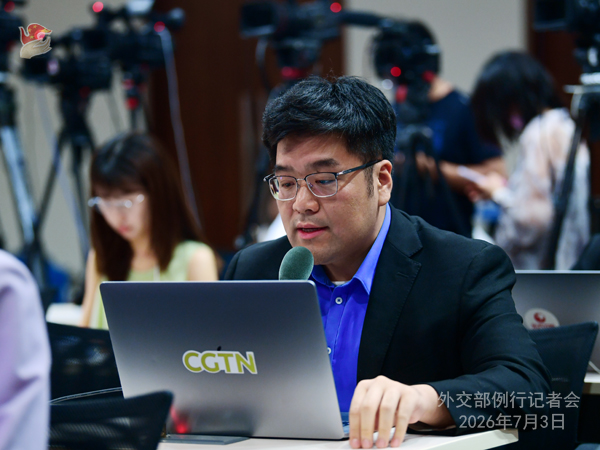
CGTN: It is reported that the second Chinese government’s medical expert team has departed recently for the DRC. Can you share more details?
Guo Jiakun: China attaches great importance to the new Ebola outbreak in Africa and promptly sent its first five-member medical expert team to the Democratic Republic of the Congo (DRC) to provide services and guidance for the Ebola response. The team’s work has been highly commended by all parties. In the early hours of July 3, the second Chinese government’s medical expert team departed Beijing for the DRC. The team is composed of experts in epidemiology, clinical treatment and health quarantine. Building on the work of the first team, it will continue to strengthen exchanges with the DRC and international organizations and promote scientific and technological cooperation in light of local conditions and the needs of the DRC. As the Ebola outbreak continues to spread, China will continue providing assistance within its capacity to African countries and help Africa overcome the outbreak at an early date.
China News Service: It is reported that Taiwan’s so-called “Ministry of Foreign Affairs” said recently that Taiwan is in contact with Honduras for restoring their diplomatic relations. President of Paraguay Peña, when visiting Taiwan, said that he strongly encourage Honduras to look at the partnership that Paraguay and Taiwan have. However, Honduras’ Foreign Minister Agüero said that Honduras has already refuted claims of alleged contacts with Taiwan and reaffirmed that there have been no contacts between the two sides. In terms of international political influence, Taiwan cannot be compared with the Chinese mainland. Based on the principle of continuity of state policy, Honduras must respect the diplomatic shift made in 2023. For China, the one-China principle is not for negotiations. What’s your comment?
Guo Jiakun: We commend Foreign Minister Agüero’s remarks on China. The one-China principle is a prevailing international consensus and a basic norm in international relations. It is what the greater national interests entail and where global opinion trends and the arc of history bends. The Taiwan authorities are going against the overwhelming tide. All separatist acts aimed at “Taiwan independence” are doomed to fail and will bring nothing but shame.
Since diplomatic ties were established between China and Honduras in 2023, bilateral relations have grown rapidly on the basis of the one-China principle, with fruitful outcomes in practical cooperation. Facts have fully proven that the establishment of diplomatic relations serves the fundamental and long-term interests of both countries and peoples. On the basis of the one-China principle, China stands ready to advance relations with Honduras for the greater benefit of both peoples.
Bloomberg: Bloomberg has reported that some leading European powers now accept that ships transiting through the Strait of Hormuz will have to pay fees to Iran and Oman, citing people familiar with the matter. We are wondering if China would consider acceptable when it comes to fees? Are there concerns that this would be setting a precedent?
Guo Jiakun: The Strait of Hormuz is a strait for international navigation. Resuming safe and free passage in the Strait at an early date serves the interests of all sides. A proper settlement is needed to address issues concerning the passage through the Strait of Hormuz and the shared concerns in the international community need a proper response. China stands ready to maintain communication on this with relevant countries and the international community.