


People’s Republic of China


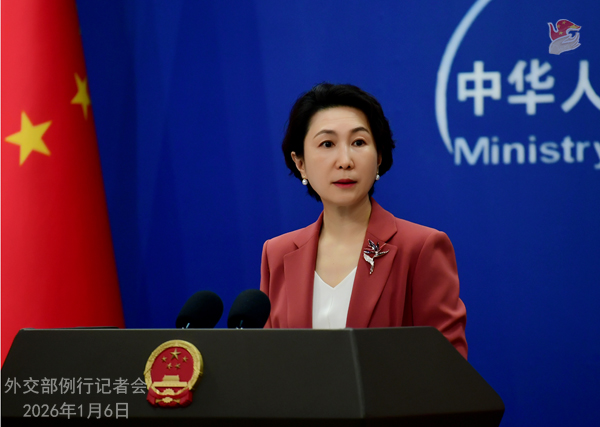
CCTV: It’s reported that Japanese Prime Minister Sanae Takaichi held a New Year’s press conference where she said challenges to a free and open international order based on the rule of law are gaining momentum. She mentioned that in the “Indo-Pacific,” China and the DPRK are increasing military power, and the cooperation between China and Russia and the cooperation between Russia and the DPRK have been enhanced. Takaichi also noted that in order to respond appropriately to the rapid changes in the security environment and with strong determination to protect Japan’s independence and peace as well as the lives and livelihood of the Japanese people, the country will proceed with discussions with the aim of revising the three national security documents by the end of this year. What’s China’s comment?
Mao Ning: According to Japanese media reports, major adjustments to the three national security documents include increasing defense spending, revising the three non-nuclear principles, lifting restrictions on arms export and developing offensive military capability. It reflects the dangerous trend of Japan “remilitarizing” itself faster, which is bound to undermine regional peace and stability. The international community must stay on high alert.
With the aim of preventing the revival of Japanese militarism, a series of instruments with legal effect under international law, including the Cairo Declaration and the Potsdam Proclamation, clearly require Japan to be “completely disarmed” and not to maintain such industries as “would enable her to re-arm for war.” Japan’s Constitution also made strict restrictions on the country’s military forces, the right of belligerency and the right to war. However, in recent years, right-wing forces in Japan have been expediting military buildup and gradually breaking free from postwar norms such as the exclusively defense-oriented principle and a series of international rules, which constitutes a challenge to the postwar international order. The right-wing forces time and again used disguises and fabricated false narratives, and kept shifting focus, provoking its neighbors, creating troubles and stirring up tensions. They even pretended to be “threatened” and caught in a dead end. In fact, they are using “survival” and “defense” as an excuse to tie the Japanese people to the war chariot to serve their hidden agenda. What’s the difference between their practice and what the Japanese militarists did in the last century?
The painful lessons of history remind us that Japanese right-wing forces’ “remilitarization” attempt has posed a threat to regional and world peace and tranquility. China and all peace-loving countries and people in the world should never allow Japanese right-wing forces to turn back the wheel of history or allow the revival of militarism.
Telesur: Given that the vast majority of countries on the Security Council expressed their condemnation of the U.S. military action and their support for Venezuela’s sovereignty during the emergency UN meeting, how does the Chinese government plan to cooperate with other member states and the international community to protect Venezuela’s sovereignty and security? Furthermore, considering that other countries in the region, such as Cuba, Colombia and Mexico, could also be subjected to pressure or intervention, what measures does China consider effective in preventing the United States from acting as the “world’s sheriff”?
Mao Ning: Yesterday, the UN Security Council held an emergency meeting regarding the U.S. military strikes on Venezuela. China’s representative stressed in his remarks that military means are not the solution to problems, and the indiscriminate use of force will only lead to greater crises. China firmly supports the government and people of Venezuela in safeguarding their sovereignty, security, and legitimate rights and interests and firmly supports regional countries in upholding the status of Latin America and the Caribbean as a zone of peace. We stand ready to work with regional countries and the international community to jointly safeguard peace and stability in Latin America and the Caribbean.
China believes that all countries should respect the development paths chosen by the people of other countries, and abide by international law and the purposes and principles of the UN Charter. Major countries, in particular, should set a good example. No country should act as the world’s police or judge. China champions the vision of common, comprehensive, cooperative and sustainable security, respects all countries’ sovereignty and territorial integrity, takes other countries’ legitimate security concerns seriously, and supports resolving differences and disputes peacefully through dialogue and consultation. This is China’s solution for global security challenges and towards universal and common security.
China stands ready to work with other countries to defend the authority of international law, reject the law of the jungle, oppose interference in countries’ internal affairs and jointly uphold world peace and stability.
AFP: The Japanese lawmaker Hei Seki is in Taiwan at the moment. He said that his visit would show that Taiwan is an “independent country.” Does the Foreign Ministry have a response to this?
Mao Ning: The bluster of a despicable man is not worth any comment.
Ukrinform News Agency: After the situation in Venezuela, China and its Foreign Ministry condemned the U.S. actions and called to respect the sovereignty of all countries. Chinese leader stated that all countries should respect the development paths chosen by the peoples of other nations. At the same time, the conflict between Russia and Ukraine has lasted for almost four years. Civilian Ukrainians were killed and the territory of Ukraine was occupied. So, my question is: from China’s perspective, what is the difference between the situation in Venezuela and Ukraine, and whether China’s calls to respect the sovereignty also apply to the Ukrainian state?
Mao Ning: China’s position on the Ukraine crisis is very clear. President Xi Jinping put forward four principles as our fundamental guidance, namely, the sovereignty and territorial integrity of all countries should be respected, the purposes and principles of the UN Charter should be observed, the legitimate security concerns of all countries should be taken seriously, and all efforts conducive to a peaceful settlement of the crisis should be supported. Since the outbreak of the crisis, China has stayed committed to promoting talks for peace and the political settlement of the crisis. China’s objective and just position, as well as our efforts are there for all to see.
Reuters: About Venezuela, does China recognize the Venezuelan government headed by Delcy Rodriguez? Another related question to Venezuela in relation to Maduro’s capture. Analysts have said that if Russia were to capture a neighbouring country’s leader, the U.S. and its allies would have been lining up sanctions. My question is: will China as a P-5 member of the UN and head of the BRI and Global Security Initiative, for example, call for sanctions against the U.S. in this matter?
Mao Ning: On your first question, China respects Venezuela’s sovereignty and independence, and respects the arrangements made by the Venezuelan government in accordance with the country’s Constitution and laws.
On your second question, the United States, as a P5 country, disregards the grave concerns of the international community and tramples on Venezuela’s sovereignty, security and lawful rights and interests. China firmly opposes that. We support the UN Security Council in carrying out its primary responsibility for the maintenance of international peace and security.
Bloomberg: Just want to follow up on Venezuela. Ousted Venezuelan President Maduro pleaded not guilty on Monday to U.S. charges on a narco-terrorism case against him. He said through an interpreter: “I am innocent. I am not guilty. I am a decent man,” adding that he is still the president of Venezuela. He also said he had been “kidnapped” from his home. We wonder if the Foreign Ministry has any comment on this?
Mao Ning: The U.S. disregards President Maduro’s head-of-state status, blatantly prosecutes and puts him on so-called “trial” in a domestic court. That seriously violates Venezuela’s national sovereignty and destabilizes international relations. No country should put domestic rules above international law. China calls on the U.S. to release President Maduro and his wife at once and ensure their personal safety.
AFP: President Lee of South Korea said yesterday that he wanted a new phase in relations with China. I wonder what China’s view of this statement is. How do you expect the relationship with South Korea to change?
Mao Ning: President Lee Jae Myung is now paying a state visit to China. President Xi Jinping held talks with him yesterday and Premier Li Qiang met with him this morning. The readouts have been released, which you may refer to.
China and the ROK are neighbors and cooperation partners. The sound and steady development of China-ROK relations serves the fundamental interests of the two countries and peoples. We would like to work with the ROK for more tangible achievements in the development of our relations in the new year.
Reuters: It is related to South Korea. Does China welcome more South Korean culture exports in the future? What would China do to facilitate their resumption?
Mao Ning: Both China and the ROK agree to carry out beneficial cultural exchanges in an orderly manner.
Reuters: One last question regarding Venezuela. More than a dozen media workers were detained on Monday when covering events in Venezuelan capital Caracas, including when they were covering a march in support of Maduro. Were there any Chinese media reporters part of that detention? How safe are the reporters now covering news in Venezuela?
Mao Ning: I am not familiar with the specifics you mentioned. What I can tell you is that the Chinese government has always attached great importance to protecting the safety of Chinese nationals abroad. To my knowledge, all Chinese journalists currently in Venezuela are safe.