People’s Republic of China


China News Service: The international community closely follows China’s NPC and CPPCC Sessions, especially the target for GDP growth this year. Some say China’s downward revision of the target is partially owing to the turmoil in the Middle East, the possible impact on energy supply and uncertainties in China-U.S. relations. What’s your comment?
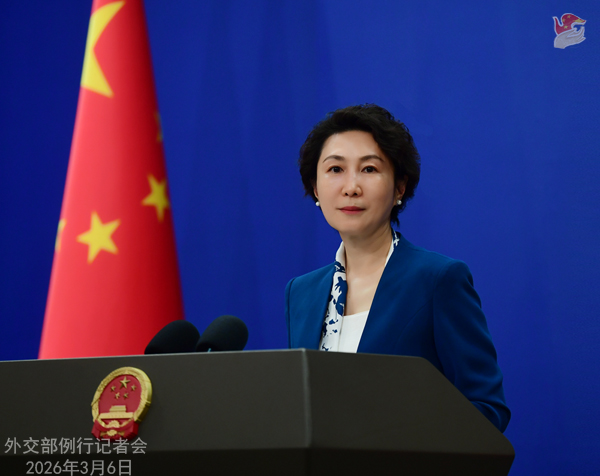
Mao Ning: When delivering the report on the work of the government yesterday, Premier Li Qiang took stock of what China has achieved during the 14th Five-Year Plan period. Gross domestic product (GDP) has taken a new leap with an annual growth of nearly RMB10 trillion. GDP increased by over RMB35 trillion for five years, equivalent to the GDP size of a medium-sized economy. These remarkable achievements have been made in a grave and complex landscape, where external shocks and challenges were intertwined with domestic difficulties and tough policy choices. This says a lot about the great resilience and vigor of China’s economy.
Looking forward, as Premier Li Qiang pointed out, we’re clearly-eyed about the difficulties and challenges we face. Yet, the conditions underpinning China’s long-term growth and underlying trend remain unchanged. More and more, China is demonstrating the strengths of its system and the strengths it has as a big country. As long as we fully tap our strengths and respond to challenges in the right way, we will surely open up even more promising prospects for China’s development. We will fully apply the new development philosophy on all fronts, move faster to foster a new pattern of development, and promote high-quality development. China will promote higher-quality economic growth while achieving an appropriate increase in economic output. We will further expand high-standard opening up, stick to mutually beneficial cooperation, steadily advance institutional opening-up, and engage at a higher level in the global economy so that more people worldwide will benefit from China’s development.
The strategic focus, policy outcomes, vitality of development, and capacity for governance demonstrated in China’s economic growth will provide much needed stability and certainty to a turbulent world.
Bloomberg: Russia and China are supporting Iran “politically and otherwise.” This is according to the Iranian foreign minister. Could you tell us what kind of support that China is providing, politically or otherwise, to Iran? Is there any military or dual use support?
Mao Ning: China opposes the U.S. and Israel launching military strikes against Iran in violation of international law. We support Iran in safeguarding its sovereignty, security, territorial integrity and national dignity and in upholding its legitimate and lawful rights and interests. China always advocates resolving issues through political and diplomatic means. We call for an immediate stop to the military actions to prevent the conflict from spreading and spilling over and avoid further escalation of the situation.
Reuters: China is in talks with Iran to allow crude oil and Qatari liquefied natural gas vessels safe passage through the Strait of Hormuz, as the U.S.-Israeli war on Tehran intensifies. Diplomatic sources told Reuters. Is the Foreign Ministry able to confirm this?
Mao Ning: The Strait of Hormuz and its adjacent waters are an important international trade route for goods and energy. To keep the region secure and stable serves the common interests of the international community. China urges relevant parties to immediately stop military operations, avoid further escalation of the tense situation and prevent regional turmoil from causing greater damage to global economic growth.
CCTV: Airspace closures in some Middle East countries due to the current situation have caused massive travel disruptions, including among Chinese passengers. What steps has the Chinese government taken to provide assistance?
Mao Ning: We attach high importance to Chinese passengers being stranded in Middle East countries. Since the strikes began, our Ministry has immediately activated emergency response mechanism, and instructed relevant diplomatic missions to engage with their host countries and do everything they can to provide assistance to stranded Chinese compatriots. The Foreign Ministry also urgently worked with the Civil Aviation Administration and other competent authorities for the early resumption of flights by airlines while ensuring safety.
With the joint effort of various parties, positive progress has been made. On the night of March 4, nearly 300 Chinese nationals safely arrived in Guangzhou from Dubai via foreign flight. Air China, China Eastern Airlines, China Southern Airlines and Hainan Airlines are gradually resuming round-trip flights to countries including the UAE, Oman and Saudi Arabia starting from March 5.
We once again caution that the current situation in the Middle East remains complex and severe with high uncertainties. We remind Chinese nationals to avoid traveling to countries and regions affected by the military conflict and those who are already there to closely follow relevant information and depart promptly while flights are available. If any help is needed, please contact Chinese embassies and consulates or dial consular protection hotline 12308.
Reuters: Australia’s defense force says there has been an unsafe interaction with the Chinese helicopter in the Yellow Sea. Australia says its helicopter was confronted by a Chinese helicopter and they had to take evasive actions for their safety. Is the Australian account correct? Is the Chinese Foreign Ministry able to provide more information on what happened and did the Chinese military put the Australian military at risk?
Mao Ning: I’m not familiar with that and would refer you to competent authorities.
Ukrinform News Agency: Yesterday, Iran carried out a drone attack on an international airport in Azerbaijan, a country that was in no way involved in the U.S. and Israeli strikes. This is an escalation of the conflict beyond the Middle East region. How does the Foreign Ministry comment on this?
Mao Ning: We are deeply concerned about the continued tense situation in the Middle East. The pressing priority now is to stop the military operations at once, prevent spillover of the conflict, and avoid further escalation.
EFE: U.S. President Donald Trump has called Spain a “loser” and accused it of being hostile to NATO because of its position on defense spending and its refusal to allow the use of Spanish bases for operations against Iran. What is China’s view of the current tensions between the two countries?
Mao Ning: The U.S.-Israeli military strikes on Iran violate international law. The international community needs to jointly work for peace and cessation of the fighting and maintain peace and stability in the Middle East.
Dragon TV: Elections for members of the House of Representatives of the Federal Parliament were held in Nepal on March 5. Nepal’s Election Committee held a press conference last night, announcing that the voting concluded smoothly and peacefully, and estimated turnout reached around 60 percent. What is China’s comment?
Mao Ning: China congratulates Nepal on concluding the voting for the House of Representatives elections steadily and as scheduled. We are glad to see Nepal advance its political agenda smoothly. As a traditionally friendly neighbor, China values its relations with Nepal. The two countries have given each other support in their effort to safeguard independence, sovereignty and territorial integrity. China stands ready to work with Nepal to continue advancing the strategic partnership of cooperation featuring ever-lasting friendship for development and prosperity.
Ukrinform News Agency: Since the Iranian crisis started, Chinese officials made many statements that attacks on Iran are a violation of international law, that attacks on civilians are a red line. However, over the past four years when Ukrainian civilians suffered from the war, the Chinese side is silent and doesn’t express simple human sympathy. So, my question is: can the Foreign Ministry explain such selectivity?
Mao Ning: That’s inconsistent with facts. It is China’s consistent position to resolve differences and disputes through dialogue and consultation, not resort to the use of force arbitrarily, and protect civilians in military conflicts. On the Ukraine crisis, President Xi Jinping laid out four points about what should be done. Most recently, he further outlined a three-point proposition. China released a position document on this issue as well. All of them fully reflect China’s position, which you may refer to.