People’s Republic of China


CCTV: It was reported that on December 3, regarding Japanese Prime Minister Sanae Takaichi’s remarks on Taiwan, Vice-President of the Liberal Democratic Party Taro Aso expressed support for Takaichi’s attitude. What is China’s comment?
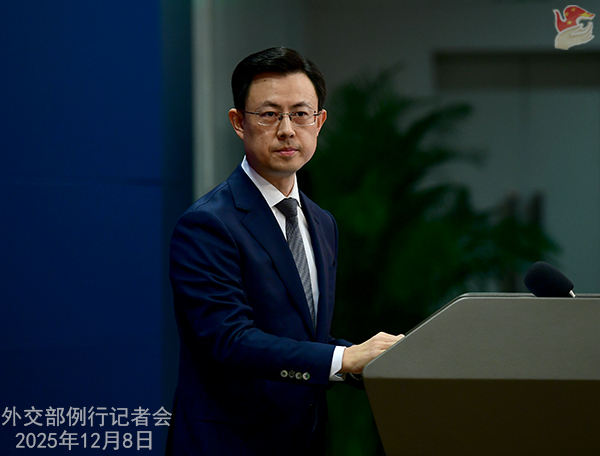
Guo Jiakun: This Japanese politician’s remarks demonstrate that Prime Minister Sanae Takaichi and the right-wing provocateurs behind her still misjudge the situation, refuse to do soul-searching or correct the wrongdoings, turn a deaf ear to criticism in and outside Japan, downplay and whitewash interference in other countries’ internal affairs and threat of force in disregard of facts, show no basic respect to international law and basic norms of international relations, and attempt to break free from the post-war international order and revive militarism in Japan by stoking conflict and confrontation. This should put Japan’s Asian neighbors and the international community on high alert.
It needs to be pointed out that attempting to grab attention and reap public support by provoking China is malign in nature and very dangerous. We urge the Japanese side to seriously reflect on and repent for its wrongdoing, simply retract Prime Minister Takaichi’s erroneous remarks, stop playing with fire, and avoid going further down the wrong path.
China-Arab TV: The King of Spain and the French President just visited China, and the German Foreign Minister will visit soon. What is China’s comment? Is Europe turning to China for more cooperation?
Guo Jiakun: China and European countries have had close high-level exchanges this year. Leaders of the two sides reached important common understandings on and provided strategic guidance for further growing the strategic partnership and deepening mutually beneficial cooperation. Amid the increasingly turbulent international situation, closer strategic communication and deeper dialogue and cooperation between China and Europe serves the interests of both sides and the wider world.
China stands ready to work with Europe to deliver on the common understandings between the leaders of the two sides, enhance solidarity and coordination, and promote the sound and steady development of China-Europe relations. The two sides need to jointly uphold multilateralism, support free trade, defend the postwar international order and international rules, oppose unilateralism and bullying moves, jointly address global challenges such as climate change, and improve global governance, so as to benefit the people of both sides and provide greater stability and certainty to the turbulent world.
DPA: German Foreign Minister Johann Wadephul, before heading to China, said yesterday that “no other country has as much influence on Russia as China” to promote the peaceful settlement of the Ukraine crisis. What’s the Foreign Ministry’s comment and why has China not yet successfully influenced Russia on that?
Guo Jiakun: China and Germany are comprehensive strategic partners. Over the past 53 years since the establishment of diplomatic relations, China-Germany relations have maintained a sound momentum of development and delivered tangibly for the two countries and the two peoples. In May this year, President Xi Jinping had a phone call with German Chancellor Friedrich Merz, charting the course for the bilateral ties. Given the volatile and turbulent international landscape, to consolidate and develop the relations between China and Germany, two major countries and key economies in the world, not only serves their own interests but also promotes world peace and prosperity.
This is Foreign Minister Johann David Wadephul’s first visit to China since he took office. Foreign ministers of the two countries will have in-depth communication on China-Germany and China-EU relations as well as international and regional hotspot issues of mutual interest. China always views its relations with Germany from a strategic height and long-term perspective. We stand ready to work with Germany to implement the important common understandings reached between leaders of the two countries, step up strategic communication, enhance understanding and mutual trust, expand mutually beneficial cooperation, and promote the sustained, sound and steady development of China-Germany relations.
We will release relevant information on the visit in due course. Please check back for updates.
China News Service: The Chinese Navy hospital ship Ark Silk Road has arrived in the Montego Bay, Jamaica to provide medical services to local communities affected by the hurricane. Can you brief us on that?
Guo Jiakun: The Chinese Navy hospital ship Ark Silk Road arrived in Jamaica last week and will dock at multiple ports to provide humanitarian medical service to the people hit by Hurricane Melissa.
China feels for Jamaica over the devastating hurricane and has provided emergency disaster relief assistance in light of Jamaica’s need. We believe that the hospital ship Ark Silk Road will bring China’s friendship to the affected communities and help the Jamaican people recover and rebuild from the disaster with greater confidence.
Kyodo News: The Japanese Defense Ministry said that Chinese naval fighter jets intermittently targeted radar at Japanese Self-Defense Force fighter jets on December 6. What is the purpose of the radar illumination?
Guo Jiakun: The Chinese side has stated its serious position on the issue. The facts are very clear. China’s exercise and training in relevant waters and airspace fully complies with the international law and international practice. Our maneuvers are professional, standard, and beyond reproach. To activate search radar during flight training is commonly done by carrier-based aircraft of all countries. It’s also a normal measure to ensure flight safety. The incident arose from Japanese jets’ deliberate intrusion into China’s exercise and training zones and close-in reconnaissance and disruptions on China’s normal military activities. Yet, the Japanese side blamed it on China and sought to mislead the world by falsely accusing China of “radar illumination.” China deplores and opposes the false accusation and has strongly protested to the Japanese side.
It’s fairly apparent what the Japanese side is up to by spreading disinformation in military and security areas and creating tension at this particular time. We strongly urge the Japanese side to immediately stop its dangerous harassment of China’s military exercise and training, and stop all irresponsible allegations and political manipulation.
AFP: The Vatican announced on Friday that Pope Leo has ordained a new bishop to replace a bishop in China who has resigned. The Vatican called this move “a new and important step.” Can the Foreign Ministry provide more information?
Guo Jiakun: The “One Association and One Conference” (the Chinese Catholic Patriotic Association and the Bishops’ Conference of Catholic Church in China) has released relevant information. Over recent years, China and the Vatican have maintained communication and enhanced understanding and mutual trust through constructive dialogue. China stands ready to work with the Vatican to keep improving the relations between the two sides.
NHK: To follow up on the previous question about the recent aircraft incident between Japan and China, today Japan also said that they did not obstruct the safe flight of Chinese aircraft refuting to China’s claim yesterday. How does the Ministry respond to Japan’s statement?
Guo Jiakun: I’ve answered a relevant question just now. We once again stress that the facts are very clear. China’s exercise and training in relevant waters and airspace fully complies with the international law and international practice. Our maneuvers are professional, standard, and beyond reproach. We strongly urge the Japanese side to immediately stop its dangerous harassment of China’s military exercise and training, and stop all irresponsible allegations and political manipulation.
PTI: Russian President Vladimir Putin has made an eventful visit to India last week and held fruitful talks with Prime Minister Narendra Modi. Both leaders described the relationship as “a Special and Privileged Strategic Partnership.” Besides signing a host of agreements, both sides worked out an Economic Cooperation Program with the aim of diversifying trade and investment ties by 2030. Separately the Defense Ministers of both countries also met and discussed measures to enhance military-to-military ties. Ahead of his visit, President Putin said India and China are our closest friends and we treasure that relationship deeply. He also expressed confidence that India and China are committed to finding solution to their issues and Russia has no right to interfere in their bilateral affairs. How does Beijing view Mr. Putin’s visit to India and his comments on India-China relations?
Guo Jiakun: China, Russia and India are emerging economies and important members of the Global South. The three countries maintaining sound relations is not only in line with their own interests but also conducive to regional and global peace, security, stability and prosperity. China stands ready to work with Russia and India to continue advancing the bilateral relations.
On China-India ties, China stands ready to work with India to view and handle the bilateral relationship from a strategic height and long-term perspective, promote the sustained, sound and steady development of China-India ties, so as to better benefit the two countries and the two peoples and make due contributions to peace and prosperity in Asia and beyond.
Reuters: What is the Foreign Ministry’s reaction to the Trump administration’s newly released National Security Strategy, given that it says that the U.S. does not support any unilateral change to the status quo in the Taiwan Strait and also discusses the U.S. and its allies’ capacity to deny any attempt to seize Taiwan? What do you make of the document’s mentioning of the Quad grouping of nations as well?
Guo Jiakun: We noted the “National Security Strategy” report released by the U.S. government. China always believes that China and the U.S. stand to gain from cooperation and lose from confrontation. Upholding mutual respect, peaceful coexistence and win-win cooperation is the right way for China and the U.S. to get along with each other and is the only right and realistic choice. China stands ready to work with the U.S. to sustain the steady development of the bilateral relationship and at the same time will firmly defend its sovereignty, security and development interests. We hope the U.S. will work with China in the same direction, act on the important common understandings reached between heads of state of the two countries, step up dialogue and cooperation, properly manage differences, promote the steady, sound and sustainable development of China-U.S. relations, and inject more certainty and stability into the world.
On the Taiwan question, we stress that Taiwan is China’s Taiwan and is an inalienable part of China’s territory. The Taiwan question is at the core of China’s core interests and the first red line that must not be crossed in China-U.S. relations. Resolving the Taiwan question is a matter for the Chinese people and Chinese people only that brooks no external interference. The U.S. needs to earnestly abide by the one-China principle and the three China-U.S. joint communiqués, honor its leaders’ commitment, approach the Taiwan question with extra prudence, stop abetting and aiding separatist forces’ attempt to seek “Taiwan independence” and resist reunification through military buildup. China will never flinch in defending its sovereignty and territorial integrity.
Reuters: A quick follow-up question on the strategy document, the document also focuses very heavily on the U.S.’s commercial relationship with China, both decrying China’s trade practices but also signaling its hopes for a mutually advantageous economic relationship with China. What’s your response?
Guo Jiakun: China-U.S. economic and trade relations are mutually beneficial in nature and neither country has taken advantage of the other. Economic and trade cooperation should continue to serve as the anchor and driving force for China-U.S. relations. We hope the U.S. will work with China to act on the important common understandings between heads of state of the two countries, continuously shorten the list of problems and lengthen the list of cooperation through dialogue and consultation in the spirit of equality, mutual respect and mutual benefit, and work for more positive progress.
AFP: The South China Morning Post reported over the weekend that a Chinese policy paper omitted the term “denuclearization of the Korean Peninsula.” This topic has been covered widely in South Korean media today. Does the Foreign Ministry have any comment on this? Does the Chinese government still support denuclearization of the Korean Peninsula?
Guo Jiakun: China’s position on the Korean Peninsula issue is consistent and clear.
Asahi Shimbun: On the issue of “radar illumination,” is the radar on China’s carrier-based aircraft turned on for search purposes, not for attack?
Guo Jiakun: I just responded to relevant questions. We reiterate that the facts are very clear. China’s exercise and training in relevant waters and airspace fully complies with the international law and international practice. Our maneuvers are professional, standard, and beyond reproach. To activate search radar during flight training is commonly done by carrier-based aircraft of all countries. It’s also a normal measure to ensure flight safety. The incident arose from Japanese jets’ deliberate intrusion into China’s exercise and training zones and close-in reconnaissance and disruptions on China’s normal military activities. Yet, the Japanese side blamed it on China and sought to mislead the world by falsely accusing China of “radar illumination.” China deplores the false accusation and has strongly protested to the Japanese side. We urge the Japanese side to immediately stop its harassment of China’s military exercise and training, and stop all irresponsible allegations and political manipulation.