People’s Republic of China


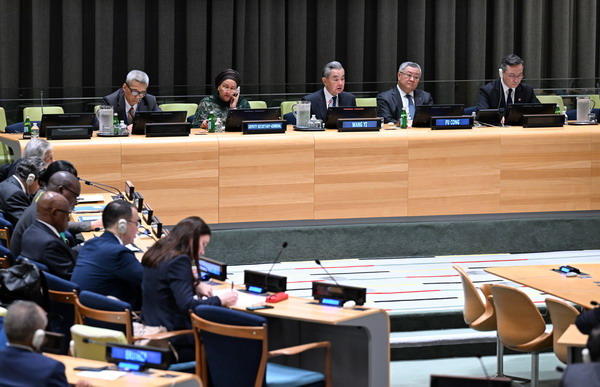
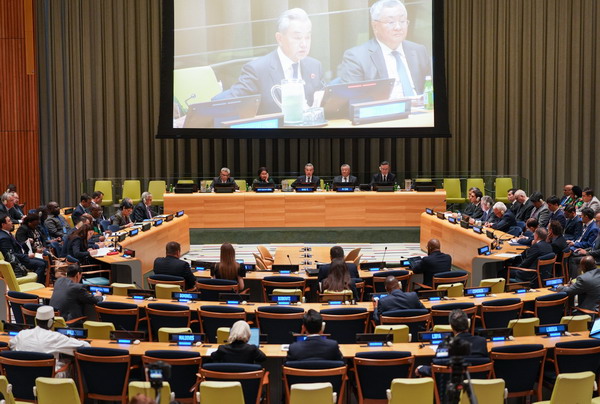
On May 28, 2026 local time, Member of the Political Bureau of the CPC Central Committee and Foreign Minister Wang Yi attended the meeting of the Group of Friends of Global Governance at the United Nations Headquarters in New York. Foreign ministers and representatives from more than 60 countries, including Pakistan, Turkmenistan, Kyrgyzstan, Cuba and Zimbabwe, attended the meeting. U.N. Deputy Secretary-General Amina J. Mohammed briefed the participants.
In his keynote speech, Wang Yi said that the current international situation is marked by intertwined changes and turbulence. Countries are calling for fairness and justice, longing for solidarity and cooperation, and aspiring to peace and stability. Against this backdrop, President Xi Jinping solemnly put forward the Global Governance Initiative last September, emphasizing five core concepts: sovereign equality, international rule of law, multilateralism, people-centered approach, and real actions. In less than a year, the initiative has received support and response from nearly 160 countries and international organizations. The Group of Friends of Global Governance has been successively established in New York, Geneva and Vienna, with membership reaching over 60 countries. Guided by the spirit of equality and mutual respect, members have held extensive discussions and reached consensus on five key points including advancing greater democracy in international relations, upholding the purposes and principles of the U.N. Charter, safeguarding the central role of the United Nations, narrowing the North-South divide, and addressing the most pressing challenges.
Wang Yi stressed that reforming and improving global governance is a historic mission for this generation. Such a task demands strong conviction and unremitting effort. China proposes the following nine reform directions:
First, promoting U.N. reform for greater efficiency. The purpose of reform is to enhance the United Nations, not weaken it. U.N. reform should be led by member states and carried out in a fair, inclusive and transparent manner. Member states should be urged to fulfill their financial obligations, and budget management and fiscal accountability should be strengthened. The Secretariat should be supported in streamlining operations and reducing burden, promoting a culture of efficiency, and effectively improving its responsiveness, service and delivery capacity.
Second, enhancing the authority and capacity of the Security Council. The voice of developing countries and the vast number of small and medium-sized countries should be strengthened, and the historical injustice faced by Africa should be addressed as a priority. The Security Council’s rules of procedure should be improved, equal consultation should be promoted, and the forced push of proposals or initiatives with obvious controversy should be avoided. The five permanent members should strengthen communication and coordination on major proposals, seek consensus as much as possible, and reduce confrontation. Unilateral actions and sanctions that bypass the Security Council should be opposed.
Third, adapting peacekeeping operations to the demands of the times. The three principles of peacekeeping should be upheld and improved, and peacekeeping operations should be better mandated and empowered. On the basis of ensuring the safety of peacekeeping personnel, the capacity of peacekeeping operations to build peace and maintain peace should be enhanced. The United Nations should be supported in strengthening coordination with regional organizations such as the African Union and the League of Arab States, so as to build a combined force for mediation on regional hotspot issues.
Fourth, building international consensus on accelerating development. Development should be pushed back to the center of the U.N. agenda, and the post-2030 development agenda should be planned ahead. Developed countries should fulfill their commitments on development financing. The principle of common but differentiated responsibilities should be upheld, and a fair, reasonable and win-win global climate governance system should be built. A new round of scientific and technological revolution and industrial transformation should be led, so that the fruits of innovative development truly benefit the whole world.
Fifth, steering global human rights governance in the right direction. The one-sided approach of placing human rights above sovereignty should be abandoned, and it should be made clear that it is the people of each country who judge and improve their own human rights. The principles of fairness, objectivity, non-selectivity and non-politicization should be advocated, and constructive dialogue and cooperation should be conducted on the basis of equality and mutual respect. The politicization, instrumentalization and weaponization of human rights should be opposed, and a fair, reasonable and inclusive global human rights governance system should be built together.
Sixth, deepening reform of the economic and financial system. The shareholding review of the World Bank should be accelerated, and a meaningful adjustment of IMF quota shares should be achieved as soon as possible. The dispute settlement mechanism should be restored to normal operation, and WTO rules should be updated to keep pace with the times. The foundational status of most-favored-nation treatment should be firmly upheld, and the different economic systems and development stages of members should be respected. The United Nations should be promoted to strengthen dialogue with emerging financial institutions such as the New Development Bank and the Asian Infrastructure Investment Bank.
Seventh, establishing rules for artificial intelligence (AI) governance. A people-centered and AI-for-good approach should be upheld, and the United Nations should be supported in playing its role as the main channel. The digital divide should be prevented from widening, and guardrails should be set for military applications and governance of AI. China has proposed the establishment of a World AI Cooperation Organization and launched and implemented the AI Capacity-Building Action Plan for Good and for All. In July this year, China will host the World AI Conference and the High-Level Meeting on Global AI Governance in Shanghai.
Eighth, strengthening governance in emerging domains such as cyberspace and outer space. The four principles of respecting cyber sovereignty, maintaining peace and security, promoting open cooperation and building good order should be upheld, and the United Nations should be supported in advancing global cyberspace and digital governance. Outer space should be used for peaceful purposes, any arms race and weaponization of outer space should be opposed, and the common rights of all countries to the peaceful use of outer space should be safeguarded.
Ninth, promoting exchanges among civilizations and achieving inclusive mutual learning. The partners of Global Civilizations Dialogue should be actively expanded, and the wisdom to solve global challenges should be drawn through dialogue among civilizations, so as to build a communication and dialogue platform that transcends geopolitical games, bloc confrontation and ideological prejudice.
Wang Yi said that the Group of Friends of Global Governance has served as a stabilizing factor and a force for justice in a turbulent world, and this mechanism should be further leveraged and strengthened. China will continue to uphold the banner of multilateralism and contribute to global governance through its own governance experience. This autumn, China will host the Xiong’an Global Governance Forum. Wang Yi expressed the hope that in Xiong’an New Area, this “city of the future”, all parties can come together to discuss plans for reforming and improving global governance and jointly build a community with a shared future for humanity.
Representatives from all participating countries spoke enthusiastically, highly praising and supporting the Global Governance Initiative. They said the initiative is consistent with the purposes and principles of the U.N. Charter, aiming to defend and practice multilateralism and strengthen the central role of the United Nations in international affairs. The nine directions proposed by China are in line with and share the same goals as the reform initiative for the U.N.’s 80th anniversary. They look forward to in-depth discussions under the framework of the Group of Friends of Global Governance around the nine reform directions, building broader consensus, forming actionable measures, strengthening solidarity and cooperation, and jointly promoting a more just and reasonable global governance system.
The meeting also issued a joint communiqué.
During his stay in New York, Wang Yi also met separately with the foreign ministers of Kyrgyzstan, Thailand, Colombia, Argentina, the Czech Republic, Azerbaijan, Costa Rica, Serbia, Cambodia, Trinidad and Tobago, Turkmenistan, Cuba, Portugal, Pakistan, Uruguay and Panama, and held a discussion with U.S. strategic and business representatives.